

Volume 26, Issue 2 (8-2026)
Social Welfare Quarterly 2026, 26(2): 45-73 |
Back to browse issues page




Download citation:
BibTeX | RIS | EndNote | Medlars | ProCite | Reference Manager | RefWorks
Send citation to:


BibTeX | RIS | EndNote | Medlars | ProCite | Reference Manager | RefWorks
Send citation to:
Maleki A, Javan Mahjoubdoost S, Mohammadi Z, Goodarzi S. (2026). Managing the Transition to Retirement of Faculty Members: A Qualitative Meta-Combination. Social Welfare Quarterly. 26(2), 45-73. doi:10.32598/refahj.26.2.4781.1
URL: http://refahj.uswr.ac.ir/article-1-4547-en.html
URL: http://refahj.uswr.ac.ir/article-1-4547-en.html

Full-Text [PDF 909 kb]
(335 Downloads)
| Abstract (HTML) (736 Views)
Full-Text: (53 Views)
Extended Abstract
Introduction
Retirement is a stage in which individuals give up their old profession. This transition involves various personal, social and economic challenges. According to the results of studies, the challenges of the years after retirement can be categorized into four types: economic and livelihood issues, health issues, physical problems, and challenges in social relationships (Amini et al., 2025). However, this experience is not entirely negative and can also create new paths. Success in this transition depends on a combination of structural factors (retirement policies, infrastructure) and individual actions (planning, mental interpretations).
This transition is more complicated for university faculty members. On the one hand, research has shown that academics experience this transition differently from other segments of society due to their academic socialization and strong professional identity. Because the elderly spend their lives with the social, cultural, and economic habits they have acquired in the field of life, and how this period is passed depends on the type, amount, and combination of economic, socio-cultural capital. (Mohammadi, 2025) On the other hand, the successful retirement of university faculty members, due to their intellectual and scientific capital, is an indicator of the success of the retirement system of any society. Therefore, studying this experience and increasing the quality of life of this group during this period can contribute to more effective social policies.
Cahill’s 2019 study addressed a similar issue. However, the present study attempts to complete the existing body of knowledge in this area in terms of methodology and findings. This article is a metasynthesis to answer these questions:
1. What challenges have retired university professors faced in the literature from 1958-2025?
2. What strategies do retired professors use to manage these challenges?
Method
The Metasynthesis article search process (last search 2 Aban 1404) was carried out in the databases PubMed, Sinhala, Google Scholar, and the Jihad Daneshgahi Scientific Information Center. The number of articles obtained from this search, which was carried out through English and Persian equivalents of the terms retirement, university professors, and combinations of these two terms and using Boolean functions (and, or), was 1910 articles, which were screened in the next stage with specific inclusion and exclusion criteria. .
The criteria for including articles in this study were the time period from 1958 to 2025, simultaneously addressing the two issues of retirement and university professors, using a qualitative method or mixed studies, and access to the full text of the articles. Only quantitative articles or articles that addressed the issue of retirement in other populations were excluded. Also, in this research, only documents that were scientific articles were collected. In the final stage,33 articles were selected that were consistent with the main research topic, challenges, and strategies of the university professors.
The quality assessment of the articles was carried out in consultation with the professors and using the CAST tool. This tool includes 10 key questions regarding the research objectives, methodology, research implementation, and accuracy of the findings. Each study was given a score based on these questions, with a maximum score of 20. All studies that were in the range of 14 to 20 reached the final acceptance stage. To achieve higher quality in presenting citations, studies that had a score above 16 were used. However, the results of the 19 articles that had a score above 16 and the results of the 33 selected articles were compared with each other and there was no significant change in the themes obtained.
Findings
Challenges and Strategies
Thirty-one articles in English and two articles in Persian were studied with the focus on challenges of retirement and strategies to manage them. After continuous back and forth and reviewing the research findings, these themes were obtained: Continuity of pre-retirement roles with post-retirement roles, Phased retirement as an alternative to mandatory retirement, Reconstruction of time, Unpleasant psychological experiences, Changing the system of interactions, Identity crisis, Pre-retirement planning. These themes include both challenges and strategies.
Discussion
The phenomenon of retirement creates challenges in different dimensions of an individual’s life. These dimensions include:
Daily activities (what should I do?), identity (who am I?), time and structure (how should I spend my time?), social interactions (who am I in contact with?), and the psychosocial dimension (how do I feel?).
By integrating the information and concepts obtained from different articles, a conceptual model was extracted to answer the current research questions.
A faculty member, influenced by structures and individual agency, takes action in the face of these challenges and tries to manage them. His individual agency is due to factors that, according to the theory of continuity, originate from his previous experiences and knowledge, and in this way he tries to find strategies along the path of existing structures. Finally, under the influence of structures and individual agency, the retirement experience is created, which has the following characteristics: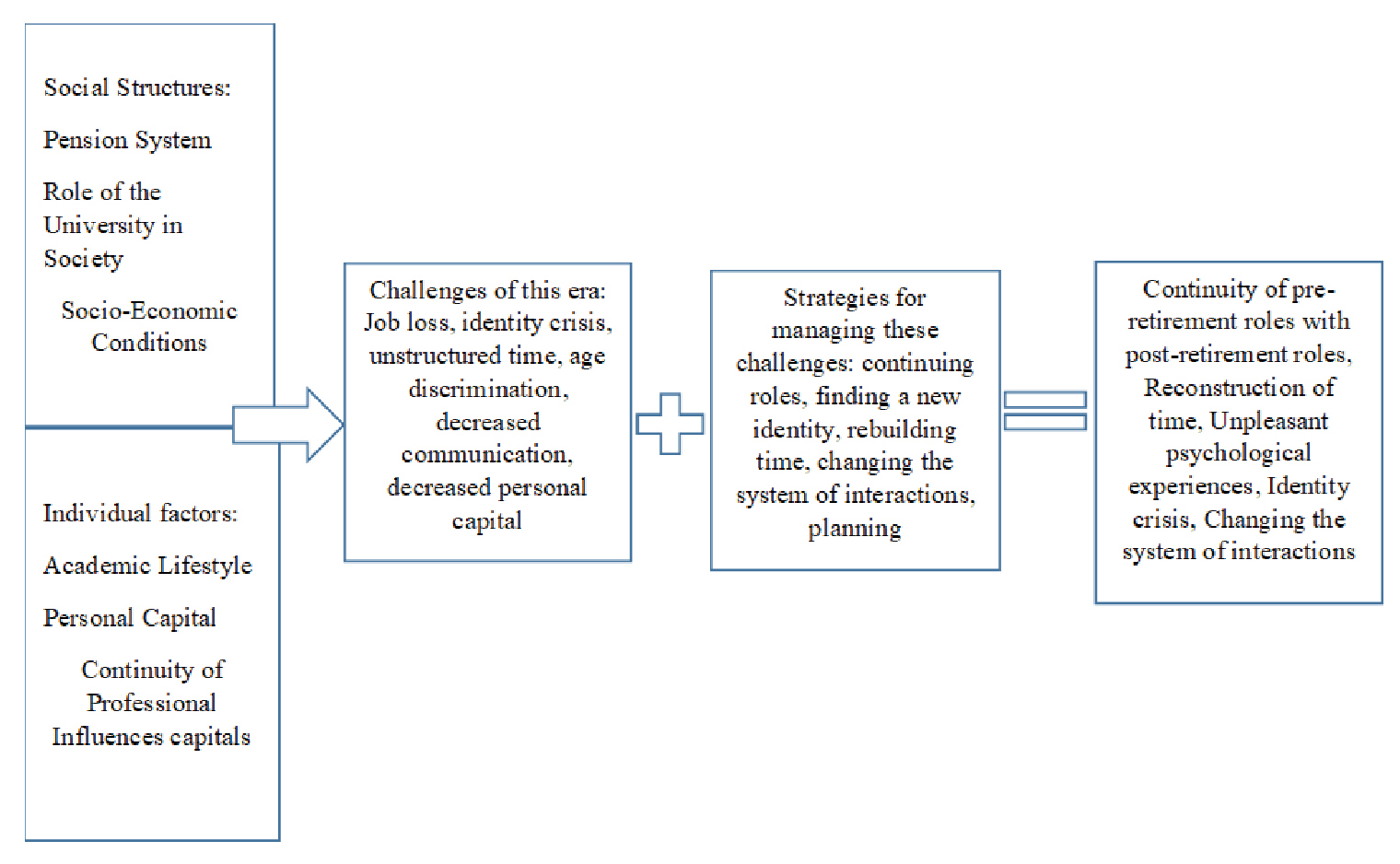 Ethical considerations
Compliance with ethical guidelines
All sources used are listed in the references section with full details. The researchers also observed ethical considerations related to the originality of sources and trustworthiness in citations.
Authors’ contribution
This article was written with the participation of all authors.
Funding
This research did not receive any financial resources.
Conflicts of interest
There is no conflict of interest in writing this article.
Acknowledgments
The authors would like to thank the reviewers for their valuable comments.
Amini, S. J., & Mohammedans, M. (2025). Resilience during retirement: Presenting a multi-level pattern. Social Welfare Quarterly, 25(96), 213-224. https://doi.org/10.32598/refahj.25.96.4567.1 (in persian)
Mohammadi, F., & Ahmadi, V. (2022). The Effect of Cultural, Economic, and Social Capital on the Quality of Life of Retired Teachers in Jawanroud County. Social Welfare Quarterly, 22(86), 235-268. https://doi.org/10.32598/refahj.22.86.3841.1 (in persian)
Introduction
Retirement is a stage in which individuals give up their old profession. This transition involves various personal, social and economic challenges. According to the results of studies, the challenges of the years after retirement can be categorized into four types: economic and livelihood issues, health issues, physical problems, and challenges in social relationships (Amini et al., 2025). However, this experience is not entirely negative and can also create new paths. Success in this transition depends on a combination of structural factors (retirement policies, infrastructure) and individual actions (planning, mental interpretations).
This transition is more complicated for university faculty members. On the one hand, research has shown that academics experience this transition differently from other segments of society due to their academic socialization and strong professional identity. Because the elderly spend their lives with the social, cultural, and economic habits they have acquired in the field of life, and how this period is passed depends on the type, amount, and combination of economic, socio-cultural capital. (Mohammadi, 2025) On the other hand, the successful retirement of university faculty members, due to their intellectual and scientific capital, is an indicator of the success of the retirement system of any society. Therefore, studying this experience and increasing the quality of life of this group during this period can contribute to more effective social policies.
Cahill’s 2019 study addressed a similar issue. However, the present study attempts to complete the existing body of knowledge in this area in terms of methodology and findings. This article is a metasynthesis to answer these questions:
1. What challenges have retired university professors faced in the literature from 1958-2025?
2. What strategies do retired professors use to manage these challenges?
Method
The Metasynthesis article search process (last search 2 Aban 1404) was carried out in the databases PubMed, Sinhala, Google Scholar, and the Jihad Daneshgahi Scientific Information Center. The number of articles obtained from this search, which was carried out through English and Persian equivalents of the terms retirement, university professors, and combinations of these two terms and using Boolean functions (and, or), was 1910 articles, which were screened in the next stage with specific inclusion and exclusion criteria. .
The criteria for including articles in this study were the time period from 1958 to 2025, simultaneously addressing the two issues of retirement and university professors, using a qualitative method or mixed studies, and access to the full text of the articles. Only quantitative articles or articles that addressed the issue of retirement in other populations were excluded. Also, in this research, only documents that were scientific articles were collected. In the final stage,33 articles were selected that were consistent with the main research topic, challenges, and strategies of the university professors.
The quality assessment of the articles was carried out in consultation with the professors and using the CAST tool. This tool includes 10 key questions regarding the research objectives, methodology, research implementation, and accuracy of the findings. Each study was given a score based on these questions, with a maximum score of 20. All studies that were in the range of 14 to 20 reached the final acceptance stage. To achieve higher quality in presenting citations, studies that had a score above 16 were used. However, the results of the 19 articles that had a score above 16 and the results of the 33 selected articles were compared with each other and there was no significant change in the themes obtained.
Findings
Challenges and Strategies
Thirty-one articles in English and two articles in Persian were studied with the focus on challenges of retirement and strategies to manage them. After continuous back and forth and reviewing the research findings, these themes were obtained: Continuity of pre-retirement roles with post-retirement roles, Phased retirement as an alternative to mandatory retirement, Reconstruction of time, Unpleasant psychological experiences, Changing the system of interactions, Identity crisis, Pre-retirement planning. These themes include both challenges and strategies.
Discussion
The phenomenon of retirement creates challenges in different dimensions of an individual’s life. These dimensions include:
Daily activities (what should I do?), identity (who am I?), time and structure (how should I spend my time?), social interactions (who am I in contact with?), and the psychosocial dimension (how do I feel?).
By integrating the information and concepts obtained from different articles, a conceptual model was extracted to answer the current research questions.
A faculty member, influenced by structures and individual agency, takes action in the face of these challenges and tries to manage them. His individual agency is due to factors that, according to the theory of continuity, originate from his previous experiences and knowledge, and in this way he tries to find strategies along the path of existing structures. Finally, under the influence of structures and individual agency, the retirement experience is created, which has the following characteristics:
Compliance with ethical guidelines
All sources used are listed in the references section with full details. The researchers also observed ethical considerations related to the originality of sources and trustworthiness in citations.
Authors’ contribution
This article was written with the participation of all authors.
Funding
This research did not receive any financial resources.
Conflicts of interest
There is no conflict of interest in writing this article.
Acknowledgments
The authors would like to thank the reviewers for their valuable comments.
Amini, S. J., & Mohammedans, M. (2025). Resilience during retirement: Presenting a multi-level pattern. Social Welfare Quarterly, 25(96), 213-224. https://doi.org/10.32598/refahj.25.96.4567.1 (in persian)
Mohammadi, F., & Ahmadi, V. (2022). The Effect of Cultural, Economic, and Social Capital on the Quality of Life of Retired Teachers in Jawanroud County. Social Welfare Quarterly, 22(86), 235-268. https://doi.org/10.32598/refahj.22.86.3841.1 (in persian)
Type of Study: orginal |
Received: 2025/11/16 | Accepted: 2026/07/29 | Published: 2026/08/31
Received: 2025/11/16 | Accepted: 2026/07/29 | Published: 2026/08/31
Send email to the article author
| Rights and permissions | |
 |
This work is licensed under a Creative Commons Attribution-NonCommercial 4.0 International License. |

Contact Information
Copyright © The Author(s);
This is an open access article distributed under the terms of the Creative Commons Attribution-NonCommercial 4.0 (CC-By-NC 4.0), which permits use, distribution, and reproduction in any medium, provided the original work is properly cited and is not used for commercial purposes.
Contact Information
