
Volume 26, Issue 1 (4-2026)
Social Welfare Quarterly 2026, 26(1): 255-282 |
Back to browse issues page




Download citation:
BibTeX | RIS | EndNote | Medlars | ProCite | Reference Manager | RefWorks
Send citation to:


BibTeX | RIS | EndNote | Medlars | ProCite | Reference Manager | RefWorks
Send citation to:
Avarideh S, Ghaffari G, Tavakolirad M. (2026). The Lived Experience of Female Social Workers: a Thematic Analysis of Occupational Burnout and Professional Agency. Social Welfare Quarterly. 26(1), 255-282. doi:10.32598/refahj.26.100.9
URL: http://refahj.uswr.ac.ir/article-1-4520-en.html
URL: http://refahj.uswr.ac.ir/article-1-4520-en.html

Keywords: Clients, Female Social Workers, Job Burnout, Occupational Experiences, Social Workers', Professional Agency.
Full-Text [PDF 519 kb]
(415 Downloads)
| Abstract (HTML) (1719 Views)
Full-Text: (4 Views)
Extended Abstract
Introduction
Social workers significantly contribute to improving clients’ quality of life. However, the profession is often associated with psychological stress, role conflict, and ambiguous working conditions. This complexity intensifies for female social workers, who must navigate familial, social, and gender-based responsibilities alongside their professional duties. Social workers encounter a professional double bind: the profession demands substantial emotional engagement with clients, while structural and organizational constraints impose additional pressures. For female social workers in Iran, these challenges are further compounded by socio-cultural expectations regarding women’s gender roles.
A review of the existing literature reveals a recurring theme in Iranian social work studies: a predominant focus on the general challenges of the profession. However, the unique experiences of women in this field have remained largely overlooked. For female social workers, the intersection of family responsibilities, professional duties, and societal pressures creates a demanding reality, often resulting in psychological, social, and physical hardships as they strive to meet competing expectations. Accordingly, the central question of this research concerns the professional experiences of female social workers regarding job burnout and professional activism. The present study seeks to investigate the occupational issues of social workers within their specific gendered and feminine context. By proposing supportive strategies, it aims to contribute to equity, address the challenges faced by female social workers, and foster their professional activism in empowering clients. This study can also illuminate pathways for future research and enrich the theoretical depth of the existing literature.
Method
A qualitative approach with thematic analysis was employed in this study. Data were collected through in-depth, semi-structured interviews. Participants were female social workers employed at welfare centers in Sowme’eh Sara. A purposive sampling method was used, and based on the principle of data saturation, 18 married female social workers in official positions participated in the research.
Findings
Rigorous analysis of the collected data revealed two main themes: (1) multi-layered occupational erosion of social workers, and (2) professional agency in client empowerment. The theme of multi-layered occupational erosion encompassed the following sub-themes: exposure to various traumas and implementation of immediate protective measures in critical situations; occupational tensions and disruptions to family interactions; organizational challenges and compassion fatigue; economic and livelihood difficulties; and professional and communicative challenges with clients. Furthermore, the theme of professional agency in client empowerment was associated with two sub-themes: social workers’ professional activism during crises, and client empowerment and participation in the social work process. The corresponding micro-themes under each main and sub-theme are detailed in the table below.
Discussion
The findings indicate that psychological and social challenges for female social workers begin from the moment they enter the work environment and initiate communication with clients and their life circumstances. Alongside a lack of organizational support, deficiencies in the support system, budget shortfalls, and high workloads with low pay, these challenges threaten the psychological well-being, job motivation, and professional efficacy of female social workers. Furthermore, female social workers—who, in addition to their professional duties, often bear the responsibility of caring for partners, children, friends, and parents, effectively managing multiple overlapping identities and social and familial expectations—are significantly more susceptible to burnout. Consequently, their mental and physical health is exposed to greater vulnerability. Female social workers, as professional agents closely aligned with the concept of empowerment, guide their clients toward active community participation by building trust, providing institutional support, and offering ongoing education. However, in this process, their own needs are often overlooked. The neglect of female social workers’ needs in the workplace not only diminishes their resilience and professional agency but also adversely impacts their maternal roles in domestic and family interactions. This study’s in-depth examination of the lived experiences of female social workers reveals that inattention to occupational stressors in social work, coupled with the absence of supportive policies and structural interventions, not only discourages role performance but also leaves vulnerable groups in need of support even more unprotected. Therefore, it is recommended that female social workers receive adequate support in their professional environments.
Ethical Considerations
Compliance With Ethical Guidelines: This research was conducted in accordance with ethical principles for human studies
Authors’ Contributions: All three authors made significant contributions to this study.
Funding: No grant or funding was received for this research.
Conflicts of Interest: The authors declare that there are no conflicts of interest in this study.
Introduction
Social workers significantly contribute to improving clients’ quality of life. However, the profession is often associated with psychological stress, role conflict, and ambiguous working conditions. This complexity intensifies for female social workers, who must navigate familial, social, and gender-based responsibilities alongside their professional duties. Social workers encounter a professional double bind: the profession demands substantial emotional engagement with clients, while structural and organizational constraints impose additional pressures. For female social workers in Iran, these challenges are further compounded by socio-cultural expectations regarding women’s gender roles.
A review of the existing literature reveals a recurring theme in Iranian social work studies: a predominant focus on the general challenges of the profession. However, the unique experiences of women in this field have remained largely overlooked. For female social workers, the intersection of family responsibilities, professional duties, and societal pressures creates a demanding reality, often resulting in psychological, social, and physical hardships as they strive to meet competing expectations. Accordingly, the central question of this research concerns the professional experiences of female social workers regarding job burnout and professional activism. The present study seeks to investigate the occupational issues of social workers within their specific gendered and feminine context. By proposing supportive strategies, it aims to contribute to equity, address the challenges faced by female social workers, and foster their professional activism in empowering clients. This study can also illuminate pathways for future research and enrich the theoretical depth of the existing literature.
Method
A qualitative approach with thematic analysis was employed in this study. Data were collected through in-depth, semi-structured interviews. Participants were female social workers employed at welfare centers in Sowme’eh Sara. A purposive sampling method was used, and based on the principle of data saturation, 18 married female social workers in official positions participated in the research.
Findings
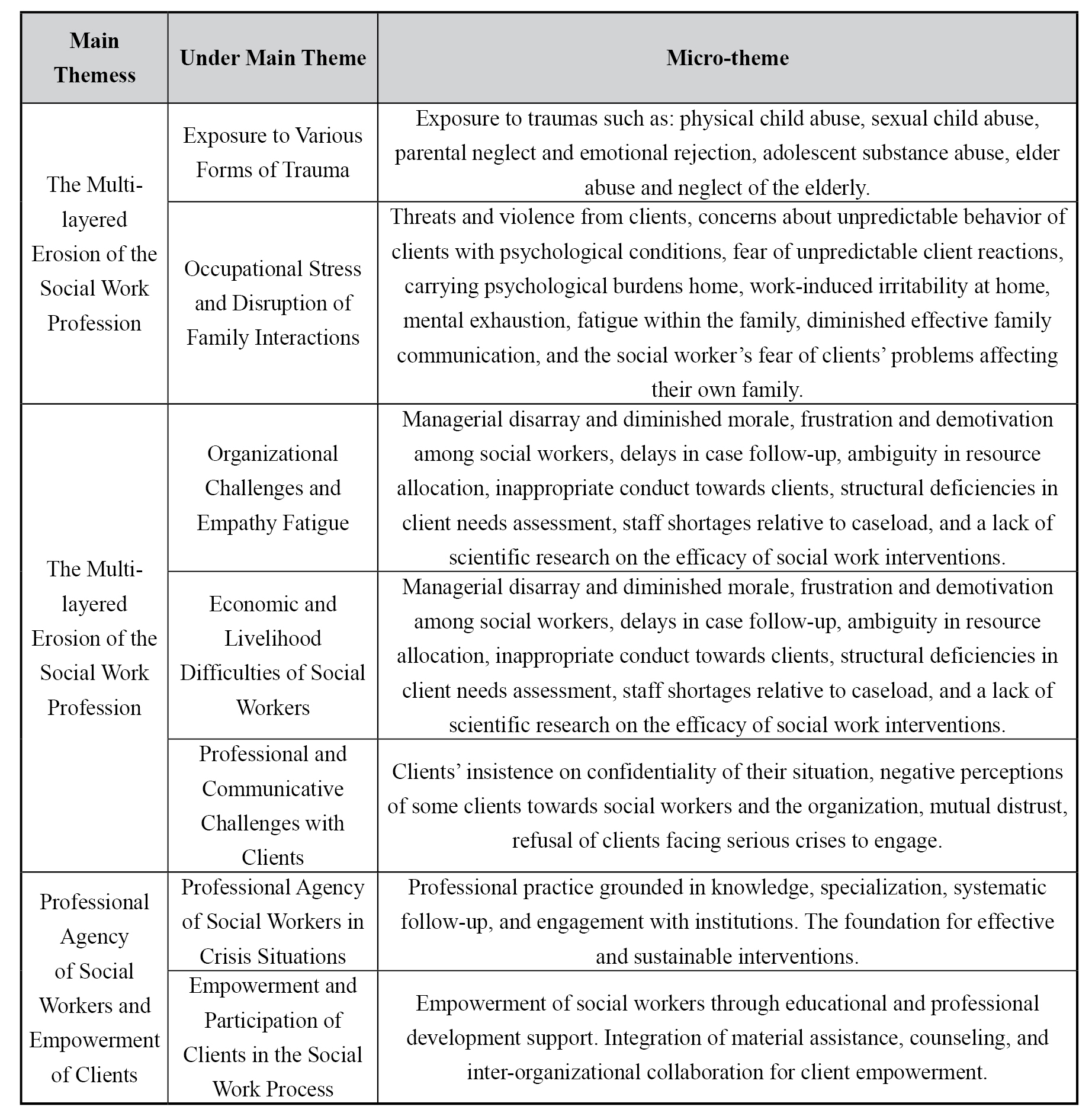
Rigorous analysis of the collected data revealed two main themes: (1) multi-layered occupational erosion of social workers, and (2) professional agency in client empowerment. The theme of multi-layered occupational erosion encompassed the following sub-themes: exposure to various traumas and implementation of immediate protective measures in critical situations; occupational tensions and disruptions to family interactions; organizational challenges and compassion fatigue; economic and livelihood difficulties; and professional and communicative challenges with clients. Furthermore, the theme of professional agency in client empowerment was associated with two sub-themes: social workers’ professional activism during crises, and client empowerment and participation in the social work process. The corresponding micro-themes under each main and sub-theme are detailed in the table below.
Themes Related to the Professional Experiences of Social Workers
Discussion
The findings indicate that psychological and social challenges for female social workers begin from the moment they enter the work environment and initiate communication with clients and their life circumstances. Alongside a lack of organizational support, deficiencies in the support system, budget shortfalls, and high workloads with low pay, these challenges threaten the psychological well-being, job motivation, and professional efficacy of female social workers. Furthermore, female social workers—who, in addition to their professional duties, often bear the responsibility of caring for partners, children, friends, and parents, effectively managing multiple overlapping identities and social and familial expectations—are significantly more susceptible to burnout. Consequently, their mental and physical health is exposed to greater vulnerability. Female social workers, as professional agents closely aligned with the concept of empowerment, guide their clients toward active community participation by building trust, providing institutional support, and offering ongoing education. However, in this process, their own needs are often overlooked. The neglect of female social workers’ needs in the workplace not only diminishes their resilience and professional agency but also adversely impacts their maternal roles in domestic and family interactions. This study’s in-depth examination of the lived experiences of female social workers reveals that inattention to occupational stressors in social work, coupled with the absence of supportive policies and structural interventions, not only discourages role performance but also leaves vulnerable groups in need of support even more unprotected. Therefore, it is recommended that female social workers receive adequate support in their professional environments.
Ethical Considerations
Compliance With Ethical Guidelines: This research was conducted in accordance with ethical principles for human studies
Authors’ Contributions: All three authors made significant contributions to this study.
Funding: No grant or funding was received for this research.
Conflicts of Interest: The authors declare that there are no conflicts of interest in this study.
Type of Study: orginal |
Received: 2025/09/7 | Accepted: 2025/12/10 | Published: 2026/05/31
Received: 2025/09/7 | Accepted: 2025/12/10 | Published: 2026/05/31
Send email to the article author
| Rights and permissions | |
 |
This work is licensed under a Creative Commons Attribution-NonCommercial 4.0 International License. |

Contact Information
Copyright © The Author(s);
This is an open access article distributed under the terms of the Creative Commons Attribution-NonCommercial 4.0 (CC-By-NC 4.0), which permits use, distribution, and reproduction in any medium, provided the original work is properly cited and is not used for commercial purposes.
Contact Information
