

Volume 26, Issue 2 (8-2026)
Social Welfare Quarterly 2026, 26(2): 141-167 |
Back to browse issues page




Download citation:
BibTeX | RIS | EndNote | Medlars | ProCite | Reference Manager | RefWorks
Send citation to:


BibTeX | RIS | EndNote | Medlars | ProCite | Reference Manager | RefWorks
Send citation to:
Saberifar R, Sadeghipour S. (2026). Perceived Social Justice in Social Security Organization Healthcare Centers in Mashhad: Spatial Accessibility and Factors Associated with Perceptions of Justice. Social Welfare Quarterly. 26(2), 141-167. doi:10.32598/refahj.26.2.580.5
URL: http://refahj.uswr.ac.ir/article-1-4529-en.html
URL: http://refahj.uswr.ac.ir/article-1-4529-en.html

Full-Text [DOCX 366 kb]
(3107 Downloads)
| Abstract (HTML) (7745 Views)
Full-Text: (64 Views)
Extended abstract
Introduction
Conflicts between medical staff and service users in healthcare centers constitute a persistent social problem that imposes significant economic and moral costs on societies each year. A substantial part of these conflicts stems from perceived injustice and unfairness in healthcare service delivery. Social justice has become a central concern in citizens’ everyday experiences, and when individuals perceive that justice is undermined, they tend to question social norms, reduce social participation, and disengage from collective responsibilities. These dynamics are particularly critical in the health sector, where access to services is directly linked to life, well-being, and human dignity. In Mashhad, the limited number and spatial concentration of Social Security hospitals raise concerns regarding equitable spatial access and the broader context in which service users form perceptions of justice. Accordingly, this study addresses three main questions: (1) Are Social Security healthcare centers in Mashhad spatially distributed in an equitable manner? (2) How do service users perceive social justice when using these services? (3) Which factors are significantly associated with perceived justice?
Method
This study employed a descriptive–analytical design. In the spatial analysis phase, the distribution of Social Security hospitals and other medical facilities in Mashhad was examined to assess accessibility gaps using the P-Median model within a GIS framework. In the survey phase, data were collected from 300 service users visiting Social Security hospitals through a researcher-designed questionnaire. Content validity was confirmed by expert review, and reliability was verified using Cronbach’s alpha (0.83). Responses were measured on a five-point Likert scale. Data analysis was conducted using GIS tools and multivariate linear regression in SPSS.
Findings
The spatial analysis revealed that only two Social Security hospitals are currently active in Mashhad, forcing a considerable proportion of residents to incur high temporal and financial costs to access healthcare services. Survey results indicated that 38% of respondents reported low levels of perceived social justice, 48% reported moderate levels, and 14% reported high levels (table 1).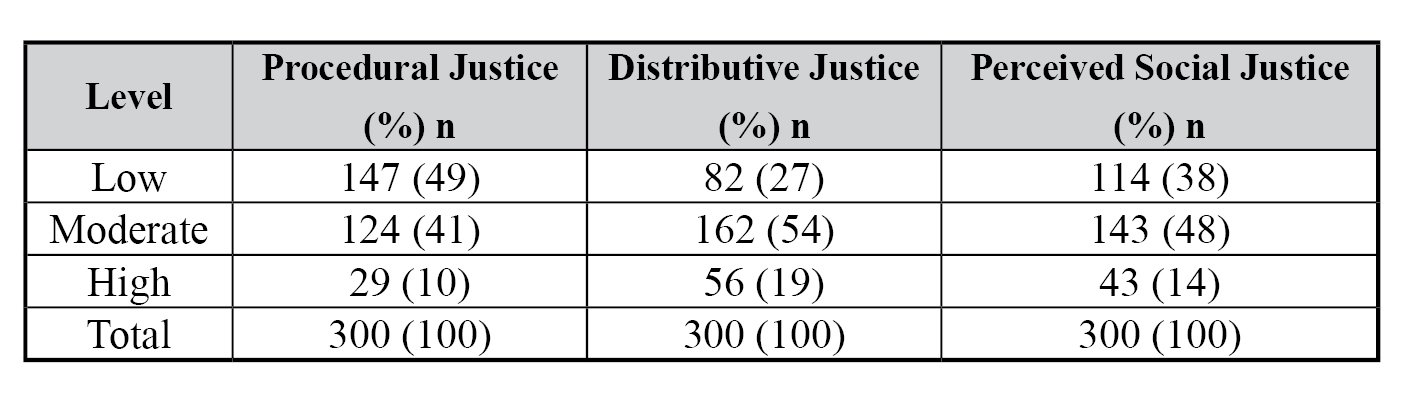
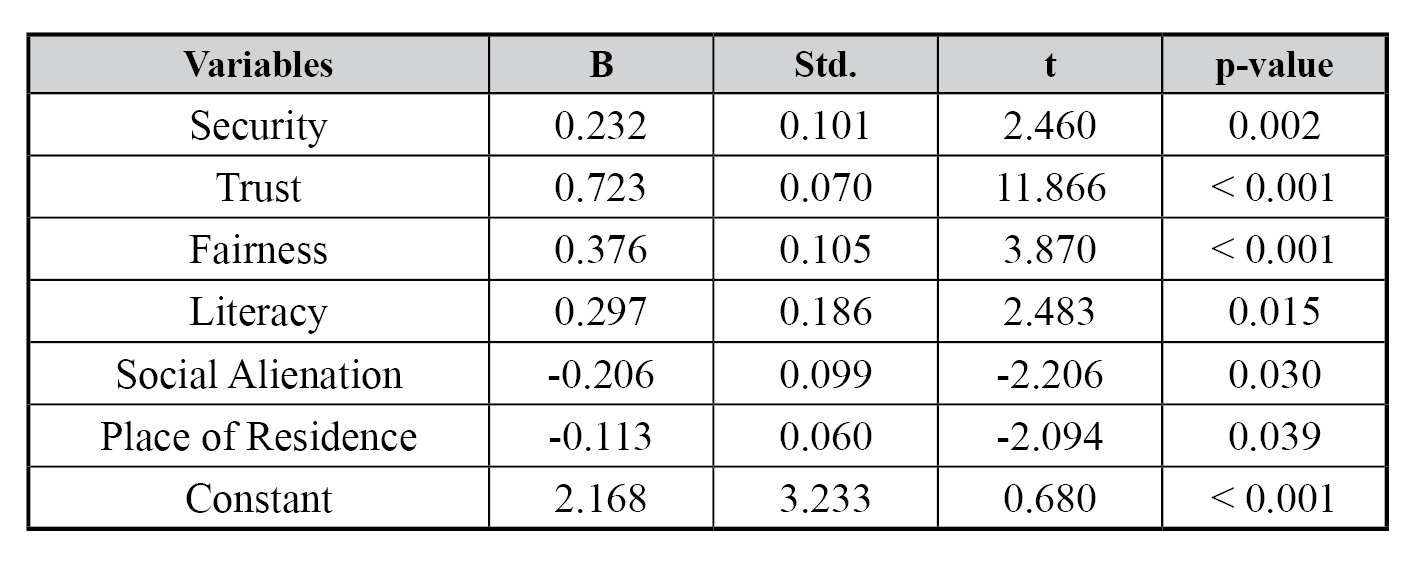
Regression analysis demonstrated that trust in staff competence, literacy level, perceived fairness, and sense of security significantly increased perceived justice, while feelings of alienation and residential neighborhood had a negative impact. Together, these variables explained 53% of the variance in perceived justice, highlighting the multidimensional nature of justice perceptions in healthcare settings (table 2).
Discussion
The findings indicate that although spatial accessibility constitutes an important contextual condition, service users’ perceptions of social justice are more strongly influenced by institutional and interactional factors. Consistent with the literature on procedural and distributive justice, trust in healthcare personnel, fairness in service provision, and a sense of security play a central role in shaping justice perceptions. Spatial inequality intensifies dissatisfaction by increasing access costs; however, it does not independently determine perceptions of justice. These results suggest that improving healthcare equity requires more than redistributing facilities across urban space. Enhancing service quality, strengthening institutional trust, and ensuring fair and respectful treatment of service users are crucial for reducing conflicts and improving patient satisfaction. Therefore, policy interventions should prioritize organizational reforms and patient-centered care alongside long-term spatial planning strategies.
Ethical Consideration
Compliance With Ethical Guidelines
All ethical principles relevant to the study were observed throughout the research process.
Authors’ contributions
The first author contributed 80% to the study, including the conceptualization, methodology, data analysis, interpretation of findings, and preparation of the manuscript. The second author contributed 20% to the study, including data collection, literature review, and revision of the manuscript. Both authors approved the final version of the manuscript.
Funding
This research received no financial support or funding from any governmental, institutional, commercial, or other external source.
Conflict of interest
The authors declare that there are no conflicts of interest related to this study or its publication.
Acknowledgments
The authors received no financial, institutional, or other external assistance in conducting or completing this research.
Introduction
Conflicts between medical staff and service users in healthcare centers constitute a persistent social problem that imposes significant economic and moral costs on societies each year. A substantial part of these conflicts stems from perceived injustice and unfairness in healthcare service delivery. Social justice has become a central concern in citizens’ everyday experiences, and when individuals perceive that justice is undermined, they tend to question social norms, reduce social participation, and disengage from collective responsibilities. These dynamics are particularly critical in the health sector, where access to services is directly linked to life, well-being, and human dignity. In Mashhad, the limited number and spatial concentration of Social Security hospitals raise concerns regarding equitable spatial access and the broader context in which service users form perceptions of justice. Accordingly, this study addresses three main questions: (1) Are Social Security healthcare centers in Mashhad spatially distributed in an equitable manner? (2) How do service users perceive social justice when using these services? (3) Which factors are significantly associated with perceived justice?
Method
This study employed a descriptive–analytical design. In the spatial analysis phase, the distribution of Social Security hospitals and other medical facilities in Mashhad was examined to assess accessibility gaps using the P-Median model within a GIS framework. In the survey phase, data were collected from 300 service users visiting Social Security hospitals through a researcher-designed questionnaire. Content validity was confirmed by expert review, and reliability was verified using Cronbach’s alpha (0.83). Responses were measured on a five-point Likert scale. Data analysis was conducted using GIS tools and multivariate linear regression in SPSS.
Findings
The spatial analysis revealed that only two Social Security hospitals are currently active in Mashhad, forcing a considerable proportion of residents to incur high temporal and financial costs to access healthcare services. Survey results indicated that 38% of respondents reported low levels of perceived social justice, 48% reported moderate levels, and 14% reported high levels (table 1).
Table 1. Distribution of Respondents by Levels of Procedural Justice, Distributive Justice, and Perceived Social Justice
Regression analysis demonstrated that trust in staff competence, literacy level, perceived fairness, and sense of security significantly increased perceived justice, while feelings of alienation and residential neighborhood had a negative impact. Together, these variables explained 53% of the variance in perceived justice, highlighting the multidimensional nature of justice perceptions in healthcare settings (table 2).
Table 2. Regression Coefficients of Predictors of Perceived Social Justice
Discussion
The findings indicate that although spatial accessibility constitutes an important contextual condition, service users’ perceptions of social justice are more strongly influenced by institutional and interactional factors. Consistent with the literature on procedural and distributive justice, trust in healthcare personnel, fairness in service provision, and a sense of security play a central role in shaping justice perceptions. Spatial inequality intensifies dissatisfaction by increasing access costs; however, it does not independently determine perceptions of justice. These results suggest that improving healthcare equity requires more than redistributing facilities across urban space. Enhancing service quality, strengthening institutional trust, and ensuring fair and respectful treatment of service users are crucial for reducing conflicts and improving patient satisfaction. Therefore, policy interventions should prioritize organizational reforms and patient-centered care alongside long-term spatial planning strategies.
Ethical Consideration
Compliance With Ethical Guidelines
All ethical principles relevant to the study were observed throughout the research process.
Authors’ contributions
The first author contributed 80% to the study, including the conceptualization, methodology, data analysis, interpretation of findings, and preparation of the manuscript. The second author contributed 20% to the study, including data collection, literature review, and revision of the manuscript. Both authors approved the final version of the manuscript.
Funding
This research received no financial support or funding from any governmental, institutional, commercial, or other external source.
Conflict of interest
The authors declare that there are no conflicts of interest related to this study or its publication.
Acknowledgments
The authors received no financial, institutional, or other external assistance in conducting or completing this research.
Type of Study: orginal |
Received: 2025/10/3 | Accepted: 2026/07/1 | Published: 2026/08/31
Received: 2025/10/3 | Accepted: 2026/07/1 | Published: 2026/08/31
Send email to the article author
| Rights and permissions | |
 |
This work is licensed under a Creative Commons Attribution-NonCommercial 4.0 International License. |

Contact Information
Copyright © The Author(s);
This is an open access article distributed under the terms of the Creative Commons Attribution-NonCommercial 4.0 (CC-By-NC 4.0), which permits use, distribution, and reproduction in any medium, provided the original work is properly cited and is not used for commercial purposes.
Contact Information
