

Volume 26, Issue 1 (4-2026)
Social Welfare Quarterly 2026, 26(1): 69-96 |
Back to browse issues page




Download citation:
BibTeX | RIS | EndNote | Medlars | ProCite | Reference Manager | RefWorks
Send citation to:


BibTeX | RIS | EndNote | Medlars | ProCite | Reference Manager | RefWorks
Send citation to:
Mayeli M. (2026). Leisure Spending Patterns of Youth in Semnan Province: A Qualitative Study. Social Welfare Quarterly. 26(1), 69-96. doi:10.32598/refahj.26.100.6
URL: http://refahj.uswr.ac.ir/article-1-4500-en.html
URL: http://refahj.uswr.ac.ir/article-1-4500-en.html

Full-Text [PDF 495 kb]
(365 Downloads)
| Abstract (HTML) (1599 Views)
Full-Text: (1 Views)
Extended Abstract
Introduction
Leisure is increasingly understood as a multidimensional construct shaped by cultural, social, economic, and political forces. In transitional societies such as Iran, it transcends the notion of “free time” and becomes a critical space for identity negotiation, symbolic resistance, and the redefinition of social roles. Among youth, leisure functions as a platform for self-expression, social bonding, and subtle contestation of structural constraints. This study explores how young people in Semnan Province, Iran, experience and navigate leisure amid intersecting dynamics of urbanization, cultural diversity, and infrastructural limitations. It conceptualizes leisure as a “field of negotiation” where structural inequalities and personal agency continuously interact, making it a critical lens for understanding youth well-being in a transitioning society.
Method
This qualitative study utilized thematic analysis. Data were collected through 35 in-depth, semi-structured interviews with youth aged 18–36 from both rural and urban areas of Semnan Province. Participants were purposively selected for maximum diversity in gender, socio-economic background, education, and location. Data collection focused on leisure practices, meanings, emotional responses, and perceived barriers. The analysis followed Braun and Clarke’s six-phase framework with inductive theme generation, ensuring contextual sensitivity and capturing nuanced variations across personal narratives.
Findings
The analysis identified seven core themes that structure the complex leisure experience of youth in Semnan (See Table 1).
The findings revealed that leisure for Semnani youth is not a neutral or universally accessible domain. It is a socially stratified experience deeply marked by the intersections of class, gender, and geography. A key insight is the primacy of gendered surveillance over class privilege in determining girls’ leisure, severely restricting their autonomy and spatial mobility. In response, youth, and particularly girls, engage in “tactical negotiations” and create informal “third spaces” to reclaim a sense of agency. The digital realm embodies a central paradox, serving both as a compensatory space for identity expression and economic initiative and as a vortex of passive consumption and time-wasting, especially where real-world options are absent.
Discussion
This study demonstrates that youth leisure in Semnan is a microcosm of broader social inequalities and a dynamic field of cultural negotiation. While confirming the powerful constraints of economic and geographic structures (Bourdieu), it highlights how gender operates as a dominant structure, often overriding class advantages for young women. The theoretical contribution lies in synthesizing Giddens’ notion of reflexive identity project with Bourdieusian structural constraints, illustrating a “situated individualism” where agency is exercised through creative rearrangement of limited resources. The dual role of digital leisure aligns with Fiske›s theory of active consumption and Castells› network society, showing its context-dependent potential for both empowerment and alienation. These findings resonate with and extend prior national studies by revealing the intensified role of local norms and spatial control in smaller cities.
Conclusion
In transitional contexts like Semnan, leisure is characterized by constraint but also by latent creativity. Despite significant limitations, youth repurpose leisure into meaningful acts of identity work, emotional recovery, and subtle everyday resistance. This understanding calls for a fundamental shift in social and cultural policy: from a top-down logic of service delivery to a supportive framework of facilitation and empowerment. Policymakers should focus on 1) co-creating safer and more inclusive public spaces with young people, especially girls, 2) supporting youth-led leisure and skill-exchange initiatives through micro-funding, and 3) developing digital literacy programs that channel online engagement toward creative production and entrepreneurship. Recognizing leisure as a right and a vital sphere for exercising agency is key to fostering youth well-being and social inclusion in societies in transition.
Ethical Considerations
Compliance With Ethical Guidelines
The study adhered to ethical standards. Written informed consent, confidentiality, and the right to withdraw were ensured. Interviews were conducted at participants’ preferred time and place, and all data remain securely stored with the author.
Authors’ contributions
The sole author performed all stages of the research (design, data collection, thematic analysis, writing).
Funding
This research received no financial support.
Conflict of interest
The author declares no conflict of interest.
Introduction
Leisure is increasingly understood as a multidimensional construct shaped by cultural, social, economic, and political forces. In transitional societies such as Iran, it transcends the notion of “free time” and becomes a critical space for identity negotiation, symbolic resistance, and the redefinition of social roles. Among youth, leisure functions as a platform for self-expression, social bonding, and subtle contestation of structural constraints. This study explores how young people in Semnan Province, Iran, experience and navigate leisure amid intersecting dynamics of urbanization, cultural diversity, and infrastructural limitations. It conceptualizes leisure as a “field of negotiation” where structural inequalities and personal agency continuously interact, making it a critical lens for understanding youth well-being in a transitioning society.
Method
This qualitative study utilized thematic analysis. Data were collected through 35 in-depth, semi-structured interviews with youth aged 18–36 from both rural and urban areas of Semnan Province. Participants were purposively selected for maximum diversity in gender, socio-economic background, education, and location. Data collection focused on leisure practices, meanings, emotional responses, and perceived barriers. The analysis followed Braun and Clarke’s six-phase framework with inductive theme generation, ensuring contextual sensitivity and capturing nuanced variations across personal narratives.
Findings
The analysis identified seven core themes that structure the complex leisure experience of youth in Semnan (See Table 1).
Table 1. Main Themes and Subthemes of Youth Leisure Experience in Semnan Province Based on Thematic Analysis
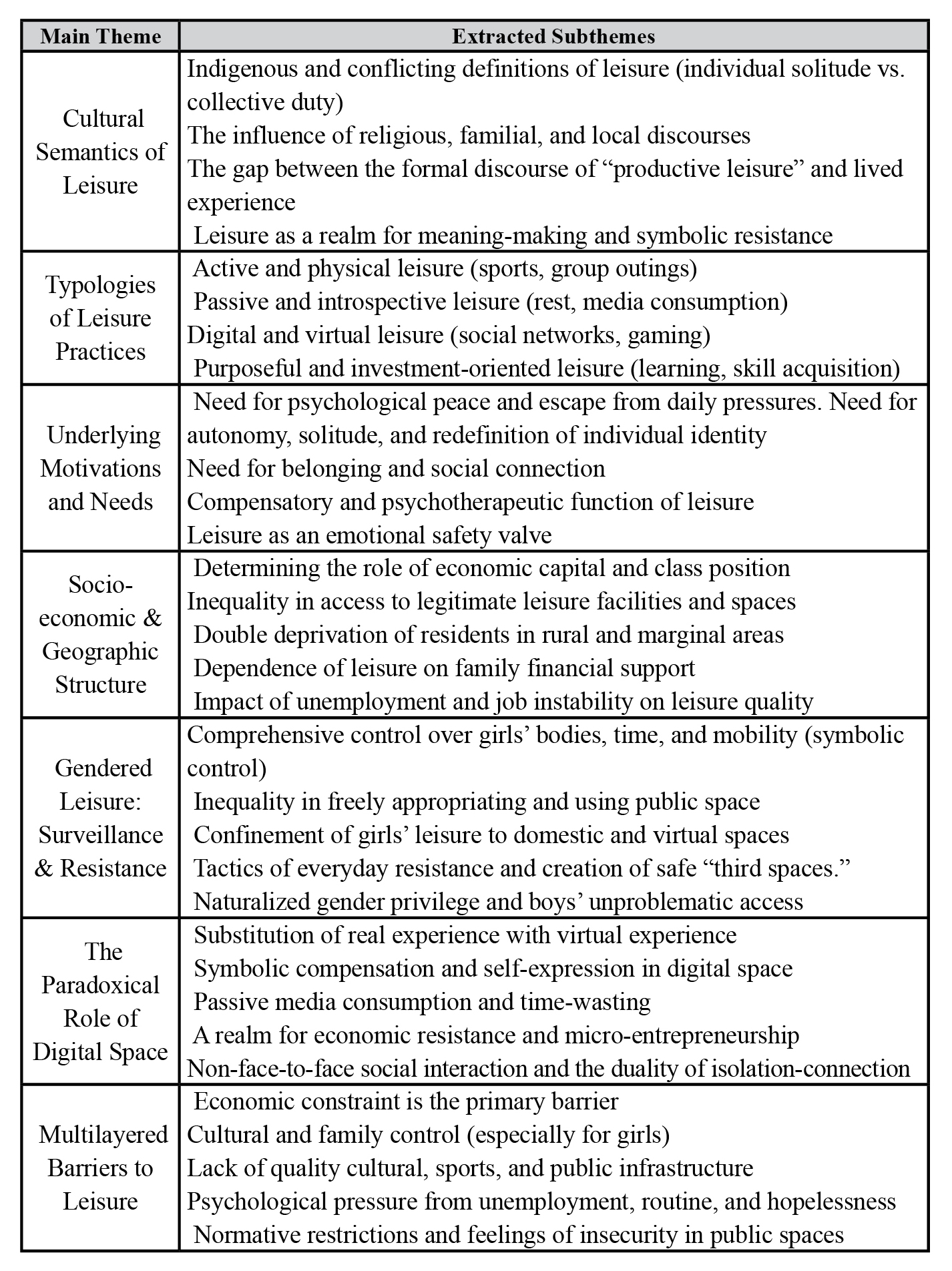
The findings revealed that leisure for Semnani youth is not a neutral or universally accessible domain. It is a socially stratified experience deeply marked by the intersections of class, gender, and geography. A key insight is the primacy of gendered surveillance over class privilege in determining girls’ leisure, severely restricting their autonomy and spatial mobility. In response, youth, and particularly girls, engage in “tactical negotiations” and create informal “third spaces” to reclaim a sense of agency. The digital realm embodies a central paradox, serving both as a compensatory space for identity expression and economic initiative and as a vortex of passive consumption and time-wasting, especially where real-world options are absent.
Discussion
This study demonstrates that youth leisure in Semnan is a microcosm of broader social inequalities and a dynamic field of cultural negotiation. While confirming the powerful constraints of economic and geographic structures (Bourdieu), it highlights how gender operates as a dominant structure, often overriding class advantages for young women. The theoretical contribution lies in synthesizing Giddens’ notion of reflexive identity project with Bourdieusian structural constraints, illustrating a “situated individualism” where agency is exercised through creative rearrangement of limited resources. The dual role of digital leisure aligns with Fiske›s theory of active consumption and Castells› network society, showing its context-dependent potential for both empowerment and alienation. These findings resonate with and extend prior national studies by revealing the intensified role of local norms and spatial control in smaller cities.
Conclusion
In transitional contexts like Semnan, leisure is characterized by constraint but also by latent creativity. Despite significant limitations, youth repurpose leisure into meaningful acts of identity work, emotional recovery, and subtle everyday resistance. This understanding calls for a fundamental shift in social and cultural policy: from a top-down logic of service delivery to a supportive framework of facilitation and empowerment. Policymakers should focus on 1) co-creating safer and more inclusive public spaces with young people, especially girls, 2) supporting youth-led leisure and skill-exchange initiatives through micro-funding, and 3) developing digital literacy programs that channel online engagement toward creative production and entrepreneurship. Recognizing leisure as a right and a vital sphere for exercising agency is key to fostering youth well-being and social inclusion in societies in transition.
Ethical Considerations
Compliance With Ethical Guidelines
The study adhered to ethical standards. Written informed consent, confidentiality, and the right to withdraw were ensured. Interviews were conducted at participants’ preferred time and place, and all data remain securely stored with the author.
Authors’ contributions
The sole author performed all stages of the research (design, data collection, thematic analysis, writing).
Funding
This research received no financial support.
Conflict of interest
The author declares no conflict of interest.
Type of Study: orginal |
Received: 2025/07/21 | Accepted: 2026/05/5 | Published: 2026/05/31
Received: 2025/07/21 | Accepted: 2026/05/5 | Published: 2026/05/31
Send email to the article author
| Rights and permissions | |
 |
This work is licensed under a Creative Commons Attribution-NonCommercial 4.0 International License. |

Contact Information
Copyright © The Author(s);
This is an open access article distributed under the terms of the Creative Commons Attribution-NonCommercial 4.0 (CC-By-NC 4.0), which permits use, distribution, and reproduction in any medium, provided the original work is properly cited and is not used for commercial purposes.
Contact Information
