

Volume 26, Issue 2 (8-2026)
Social Welfare Quarterly 2026, 26(2): 229-252 |
Back to browse issues page




Download citation:
BibTeX | RIS | EndNote | Medlars | ProCite | Reference Manager | RefWorks
Send citation to:


BibTeX | RIS | EndNote | Medlars | ProCite | Reference Manager | RefWorks
Send citation to:
Malekzadeh A, musavi S A. (2026). The Mediating Role of Men's Resilience in the Relationship Between Psychological Flexibility and Domestic Violence Against Women. Social Welfare Quarterly. 26(2), 229-252. doi:10.32598/refahj.26.2.4212.3
URL: http://refahj.uswr.ac.ir/article-1-4477-en.html
URL: http://refahj.uswr.ac.ir/article-1-4477-en.html

Full-Text [PDF 746 kb]
(661 Downloads)
| Abstract (HTML) (1000 Views)
Full-Text: (24 Views)
Extended Abstract
Introduction
The family is the first and most stable social institution in which human identity and socialization are formed, and its breakdown has profound individual and social consequences (Barros, 2023). One of the most significant threats to the family is domestic violence, which usually occurs from men toward women and includes physical, sexual, and emotional abuse (Ribeiro et al., 2022). Intimate partner violence is the most common form of violence against women worldwide (Miller & McCau, 2019).
This violence has serious physical, psychological, and reproductive consequences. According to the World Health Organization, one in five women experiences domestic violence during her lifetime. In Iran, a study in Tehran showed that 92.14% of married women experienced physical, psychological, sexual, or economic violence from their spouses, with physical violence accounting for 46.71% of cases (Ghorbani et al., 2025). Many cases remain unreported, so the real prevalence is likely higher (Pouri et al., 2015).
Psychological factors affecting domestic violence are crucial to understand. Psychological flexibility—the ability to be aware of and accept internal thoughts and emotions and to regulate behavior according to personal values and situational demands—plays an important role (Gloster et al., 2017). Individuals with higher psychological flexibility act less impulsively and maintain better marital relationships (Twistleton et al., 2020). Lack of flexibility is associated with daily dysfunction and increased likelihood of violent behavior in stressful situations (Grom et al., 2021).
Resilience can serve as a protective factor against domestic violence and may mediate the relationship between cognitive flexibility and psychological outcomes (Kubomi et al., 2022; Biligsazterk & Akbir, 2023). Resilient individuals show better self-control and adaptation in stressful situations, reducing the risk of violent behavior (Fernandez-Philo, 2024). Poor stress management and low resilience in men can increase the likelihood of violent behavior in marital conflicts (Akin & Kai, 2022).
Given the importance of these psychological variables, few studies have examined the combined role of resilience and cognitive flexibility in men regarding domestic violence. This study aims to investigate the mediating role of resilience in the relationship between cognitive flexibility and domestic violence.
Method
The present research method is descriptive-correlational. The statistical population included all married women of Varzaneh city with a population of 3,958 people in 2021. In this research, multi-stage cluster random sampling method was used. First, out of the five districts of the city, two districts were randomly selected; Then, among the 3 health centers in these two regions, 2 health centers were randomly selected. The number of married women referring to these health centers was 526. Determining the minimum required sample size is very important for structural equation modeling. Many researchers have declared the minimum required sample size to be 200 [30]. Based on this, a sample size of 230 people was selected; Then the participants (married women) answered the domestic violence questionnaire and their spouses answered the psychological flexibility and resilience questionnaires. The tools used in the current research (1) Domestic Violence Against Women Questionnaire developed by Haj‑Yahia (1999); (2) Psychological Flexibility Questionnaire (AAQ-II) by Bond et al. (2011); (3) Resilience Questionnaire developed by Freiberg et al. (2003)
Findings
The descriptive statistics of the research variables indicated that the mean, median, and mode values were close to each other, and the skewness and kurtosis values were within the range of -2 to +2, suggesting that the data were normally distributed.
The correlation matrix revealed significant relationships among the study variables. Psychological flexibility had a significant negative relationship with domestic violence (r = -0.30, p < 0.05), resilience also showed a significant negative relationship with domestic violence (r = -0.23, p < 0.05), and resilience had a significant positive relationship with psychological flexibility (r = 0.17, p < 0.05).
The structural model showed that psychological flexibility positively influenced resilience (β = 0.31), resilience negatively affected domestic violence (β = -0.41), and psychological flexibility negatively affected domestic violence (β = -0.21).
The bootstrap results in the table indicate that the indirect effect of psychological flexibility on domestic violence through men’s resilience is statistically significant, as the p-value is below 0.05 and the 95% confidence interval does not include zero. This confirms the mediating role of men’s resilience in the relationship between psychological flexibility and domestic violence against women.
Discussion
The present study aimed to predict domestic violence against women based on men’s psychological flexibility, with resilience as a mediating variable. The results showed that the proposed model met the research expectations. Psychological flexibility directly predicted domestic violence, indicating that higher psychological flexibility is associated with lower domestic violence. This finding aligns with previous studies (Gold & Marks, 2007; Miller & McCau, 2019; Grom et al., 2021). Individuals with higher psychological flexibility respond mindfully to challenges and avoid resorting to violent behaviors in marital relationships (Band et al., 2011).
A significant negative relationship was also found between resilience and domestic violence, meaning that higher resilience in men reduces the likelihood of violence against their partners. Resilient individuals manage marital stress more effectively, use problem-solving strategies instead of rumination, and are less prone to aggressive behavior (Fernandez-Philo, 2024; Yeh et al., 2020; Cameranesi et al, 2022).
Furthermore, resilience significantly mediated the relationship between psychological flexibility and domestic violence. Men with high psychological flexibility exhibited lower domestic violence, but this effect was strongest when they also possessed high resilience. Resilient individuals maintain self-control, respond constructively in difficult situations, and effectively manage stress without resorting to violence (Miller & McCau, 2019; Luther et al., 1993; Akin & Kai, 2022).
In conclusion, men with higher psychological flexibility and resilience are more likely to seek problem-solving strategies rather than using violence in stressful interpersonal situations. These findings suggest that interventions aimed at enhancing psychological flexibility and resilience in men could reduce domestic violence and help prevent family breakdown.
Ethical Considerations
Compliance with Ethical Guidelines
This study was carried out in accordance with the ethical principles governing research involving human participants.
Authors’ Contributions
All authors participated equally in the design, implementation, and preparation of all sections of this study.
Funding
This study did not receive any financial support from public, commercial, or nonprofit organizations.
Conflict of Interest
The authors declare that there are no actual or potential conflicts of interest related to the content of this article.
Acknowledgments
The authors sincerely appreciate the anonymous reviewers for their valuable comments and constructive suggestions, which significantly contributed to improving the quality of this article.
Introduction
The family is the first and most stable social institution in which human identity and socialization are formed, and its breakdown has profound individual and social consequences (Barros, 2023). One of the most significant threats to the family is domestic violence, which usually occurs from men toward women and includes physical, sexual, and emotional abuse (Ribeiro et al., 2022). Intimate partner violence is the most common form of violence against women worldwide (Miller & McCau, 2019).
This violence has serious physical, psychological, and reproductive consequences. According to the World Health Organization, one in five women experiences domestic violence during her lifetime. In Iran, a study in Tehran showed that 92.14% of married women experienced physical, psychological, sexual, or economic violence from their spouses, with physical violence accounting for 46.71% of cases (Ghorbani et al., 2025). Many cases remain unreported, so the real prevalence is likely higher (Pouri et al., 2015).
Psychological factors affecting domestic violence are crucial to understand. Psychological flexibility—the ability to be aware of and accept internal thoughts and emotions and to regulate behavior according to personal values and situational demands—plays an important role (Gloster et al., 2017). Individuals with higher psychological flexibility act less impulsively and maintain better marital relationships (Twistleton et al., 2020). Lack of flexibility is associated with daily dysfunction and increased likelihood of violent behavior in stressful situations (Grom et al., 2021).
Resilience can serve as a protective factor against domestic violence and may mediate the relationship between cognitive flexibility and psychological outcomes (Kubomi et al., 2022; Biligsazterk & Akbir, 2023). Resilient individuals show better self-control and adaptation in stressful situations, reducing the risk of violent behavior (Fernandez-Philo, 2024). Poor stress management and low resilience in men can increase the likelihood of violent behavior in marital conflicts (Akin & Kai, 2022).
Given the importance of these psychological variables, few studies have examined the combined role of resilience and cognitive flexibility in men regarding domestic violence. This study aims to investigate the mediating role of resilience in the relationship between cognitive flexibility and domestic violence.
Method
The present research method is descriptive-correlational. The statistical population included all married women of Varzaneh city with a population of 3,958 people in 2021. In this research, multi-stage cluster random sampling method was used. First, out of the five districts of the city, two districts were randomly selected; Then, among the 3 health centers in these two regions, 2 health centers were randomly selected. The number of married women referring to these health centers was 526. Determining the minimum required sample size is very important for structural equation modeling. Many researchers have declared the minimum required sample size to be 200 [30]. Based on this, a sample size of 230 people was selected; Then the participants (married women) answered the domestic violence questionnaire and their spouses answered the psychological flexibility and resilience questionnaires. The tools used in the current research (1) Domestic Violence Against Women Questionnaire developed by Haj‑Yahia (1999); (2) Psychological Flexibility Questionnaire (AAQ-II) by Bond et al. (2011); (3) Resilience Questionnaire developed by Freiberg et al. (2003)
Findings
The descriptive statistics of the research variables indicated that the mean, median, and mode values were close to each other, and the skewness and kurtosis values were within the range of -2 to +2, suggesting that the data were normally distributed.
The correlation matrix revealed significant relationships among the study variables. Psychological flexibility had a significant negative relationship with domestic violence (r = -0.30, p < 0.05), resilience also showed a significant negative relationship with domestic violence (r = -0.23, p < 0.05), and resilience had a significant positive relationship with psychological flexibility (r = 0.17, p < 0.05).
The structural model showed that psychological flexibility positively influenced resilience (β = 0.31), resilience negatively affected domestic violence (β = -0.41), and psychological flexibility negatively affected domestic violence (β = -0.21).
Table – 1 Bootstrap Results for the Indirect Effect of Psychological Flexibility on Domestic Violence via Men’s Resilience
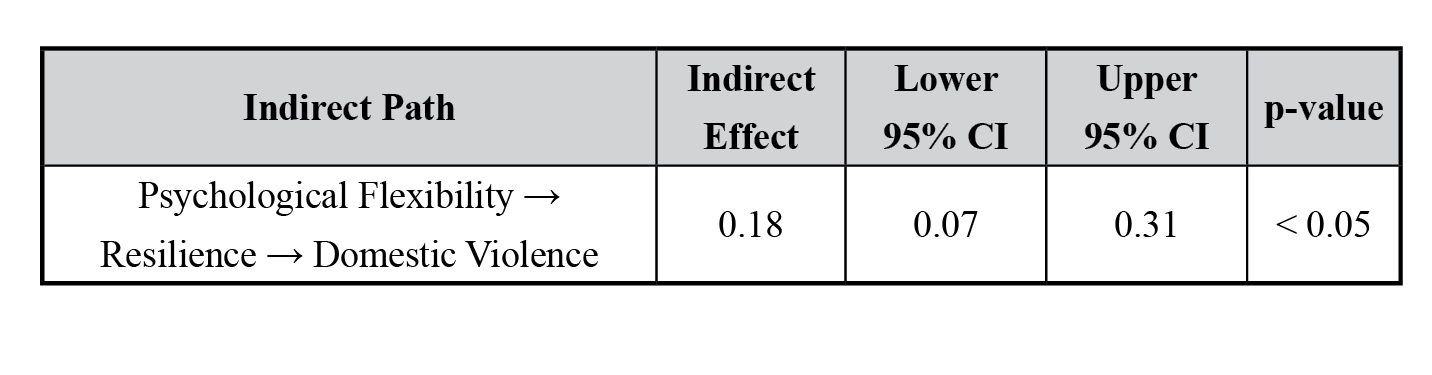
The bootstrap results in the table indicate that the indirect effect of psychological flexibility on domestic violence through men’s resilience is statistically significant, as the p-value is below 0.05 and the 95% confidence interval does not include zero. This confirms the mediating role of men’s resilience in the relationship between psychological flexibility and domestic violence against women.
Discussion
The present study aimed to predict domestic violence against women based on men’s psychological flexibility, with resilience as a mediating variable. The results showed that the proposed model met the research expectations. Psychological flexibility directly predicted domestic violence, indicating that higher psychological flexibility is associated with lower domestic violence. This finding aligns with previous studies (Gold & Marks, 2007; Miller & McCau, 2019; Grom et al., 2021). Individuals with higher psychological flexibility respond mindfully to challenges and avoid resorting to violent behaviors in marital relationships (Band et al., 2011).
A significant negative relationship was also found between resilience and domestic violence, meaning that higher resilience in men reduces the likelihood of violence against their partners. Resilient individuals manage marital stress more effectively, use problem-solving strategies instead of rumination, and are less prone to aggressive behavior (Fernandez-Philo, 2024; Yeh et al., 2020; Cameranesi et al, 2022).
Furthermore, resilience significantly mediated the relationship between psychological flexibility and domestic violence. Men with high psychological flexibility exhibited lower domestic violence, but this effect was strongest when they also possessed high resilience. Resilient individuals maintain self-control, respond constructively in difficult situations, and effectively manage stress without resorting to violence (Miller & McCau, 2019; Luther et al., 1993; Akin & Kai, 2022).
In conclusion, men with higher psychological flexibility and resilience are more likely to seek problem-solving strategies rather than using violence in stressful interpersonal situations. These findings suggest that interventions aimed at enhancing psychological flexibility and resilience in men could reduce domestic violence and help prevent family breakdown.
Ethical Considerations
Compliance with Ethical Guidelines
This study was carried out in accordance with the ethical principles governing research involving human participants.
Authors’ Contributions
All authors participated equally in the design, implementation, and preparation of all sections of this study.
Funding
This study did not receive any financial support from public, commercial, or nonprofit organizations.
Conflict of Interest
The authors declare that there are no actual or potential conflicts of interest related to the content of this article.
Acknowledgments
The authors sincerely appreciate the anonymous reviewers for their valuable comments and constructive suggestions, which significantly contributed to improving the quality of this article.
Akın Işık, R., & Kaya, Y. (2022). The relationships among perceived stress, conflict resolution styles, spousal support and marital satisfaction during the COVID 19 quarantine. Current Psychology, 41(6), 3328–3338. https://doi.org/10.1007/s12144-022-02737-4
Barros, C. (2023). Facing uncertainty: The role of the family in the development of identities. Zero-a-seis, 25(47), 322-341.
Bilgiz Öztürk, Ş., & Bilgiz Akbayır, S. (2023). The Mediator Role of Psychological Resilience in the Relationship of Cognitive Flexibility and Fear of COVID-19. Journal of Family Counseling and Education, 8(1), 41–56. https://doi.org/10.32568/jfce.1270737
Bond, F. W., Hayes, S. C., Baer, R. A., Carpenter, K. M., Guenole, N., Orcutt, H. K., Waltz, T., & Zettle, R. D. (2011). Preliminary psychometric properties of the Acceptance and Action Questionnaire–II: A revised measure of psychological inflexibility and experiential avoidance. Behavior Therapy, 42(4), 676–688. https://doi.org/10.1016/j.beth.2011.03.007
Cameranesi, M., Theron, L., Höltge, J., Jefferies, P., & Ungar, M. (2022). Understanding the mechanisms through which family risk affects adolescent mental health: A model of multisystemic resilience in context. Children, 9(4), 546. https://doi.org/10.3390/children9040546
Fernández Fillol, C., Hidalgo Ruzzante, N., Perez Garcia, M., Hyland, P., Shevlin, M., & Karatzias, T. (2024). The role of resilience in the relationship between intimate partner violence severity and ICD 11 CPTSD severity. European Journal of Psychotraumatology, 15(1), Article 2285671. https://doi.org/10.1080/20008066.2023.2285671
Friborg, O., Hjemdal, O., Rosenvinge, J. H., & Martinussen, M. (2003). A new rating scale for adult resilience: What are the central protective resources behind healthy adjustment? International Journal of Methods in Psychiatric Research, 12(2), 65–76.
Gloster, A. T., Meyer, A. H., & Lieb, R. (2017). Psychological flexibility as a malleable public health target: Evidence from a representative sample. Journal of Contextual Behavioral Science, 6(2), 166–171. https://doi.org/10.1016/j.jcbs.2017.02.003
Gold, S. D., & Marx, B. P. (2007). Gay male sexual assault survivors: The relations among internalized homophobia, experiential avoidance, and psychological symptom severity. Behaviour Research and Therapy, 45(3), 549–562. https://doi.org/10.1016/j.brat.2006.05.006
Ghorbani, S. S., Ghaffari, M., Halimi, A., Farhadi Babadi, K., & Hashemi Nazari, S. (2025). Prevalence of intimate partner violence against women and its contributing factors in Tehran, Iran. Medical Journal of the Islamic Republic of Iran, 39, 73. (In Persian) https://doi.org/10.47176/mjiri.39.73
Ghorbani, S. S., Ghaffari, M., & Hashemi Nazari, S. S. (2022). Psychometric properties of Haj-Yahia’s questionnaire of violence against women in a sample of married women in Tehran, Iran. BMC Public Health, 22, 448. (In Persian) https://doi.org/10.1186/s12889-022-12831-8
Grom, J. L., Maloney, M. A., Parrott, D. J., & Eckhardt, C. I. (2021). Alcohol, trait anger, and psychological flexibility: A laboratory investigation of intimate partner violence perpetration. Journal of Contextual Behavioral Science, 19, 100–107. https://doi.org/10.1016/j.jcbs.2021.01.006
Haj-Yahia, Muhammad M. (1999). Wife abuse and its psychological consequences as revealed by the First Palestinian National Survey on Violence Against Women. Journal of Family Psychology, 13(4), 642–662.
https://doi.org/10.1037/0893-3200.13.4.642
Клименко, І., & Конев, О. (2022). Вивчення інтенсивності та видів насилля у сім’ях військовослужбовців [Study of the intensity and types of violence in military families]. Науковий часопис УДУ імені Михайла Драгоманова. Серія 12. Психологічні науки, 20(65), 24–33. https://doi.org/10.31392/NPU-nc.series12.2022.20(65).03
Koohboomi, Z., Ghamari, M., & Hosseinian, S. (2022). Predicting quality of life and domestic violence against women during COVID-19 quarantine based on resilience and coping styles. Journal of Kermanshah University of Medical Sciences, 26(2), e120264. https://doi.org/10.5812/jkums-120264
Luthar, S. S., Doernberger, C. H., & Zigler, E. (1993). Resilience is not a unidimensional construct: Insights from a prospective study of inner-city adolescents. Development and Psychopathology, 5(4), 703–717. https://doi.org/10.1017/S0954579400006246
Miller, E., & McCaw, B. (2019). Intimate partner violence. New England Journal of Medicine, 380(9), 850–857. https://doi.org/10.1056/NEJMra1807166
Puri, M., Misra, G., & Hawkes, S. (2015). Hidden voices: Prevalence and risk factors for violence against women with disabilities in Nepal. BMC Public Health, 15(1), 1–1.
Ribeiro, R., Almeida, I., Saavedra, R., Caridade, S., Oliveira, A., Santos, M., & Soeiro, C. (2022). The different contexts of domestic violence before and during the COVID 19 pandemic: A Portuguese overview. Victims & Offenders, 17(8), 1224–1240. https://doi.org/10.1080/15564886.2022.2052214
Twiselton, K., Stanton, S. C. E., Gillanders, D., & Bottomley, E. (2020). Exploring the links between psychological flexibility, individual well-being, and relationship quality. Personal Relationships, 27(4), 880–906. https://doi.org/10.1111/pere.12344
World Health Organization. (2021). Violence against women prevalence estimates, 2018: Global, regional and national prevalence estimates for intimate partner violence against women and global and regional prevalence estimates for non-partner sexual violence against women. The Lancet, 398(10296), 803–813.
Ye, B., Zhou, X., Im, H., Liu, M., Wang, X. Q., & Yang, Q. (2020). Epidemic rumination and resilience on college students’ depressive symptoms during the COVID-19 pandemic: The mediating role of fatigue. Frontiers in Public Health, 8, 560983. https://doi.org/10.3389/fpubh.2020.560983
Barros, C. (2023). Facing uncertainty: The role of the family in the development of identities. Zero-a-seis, 25(47), 322-341.
Bilgiz Öztürk, Ş., & Bilgiz Akbayır, S. (2023). The Mediator Role of Psychological Resilience in the Relationship of Cognitive Flexibility and Fear of COVID-19. Journal of Family Counseling and Education, 8(1), 41–56. https://doi.org/10.32568/jfce.1270737
Bond, F. W., Hayes, S. C., Baer, R. A., Carpenter, K. M., Guenole, N., Orcutt, H. K., Waltz, T., & Zettle, R. D. (2011). Preliminary psychometric properties of the Acceptance and Action Questionnaire–II: A revised measure of psychological inflexibility and experiential avoidance. Behavior Therapy, 42(4), 676–688. https://doi.org/10.1016/j.beth.2011.03.007
Cameranesi, M., Theron, L., Höltge, J., Jefferies, P., & Ungar, M. (2022). Understanding the mechanisms through which family risk affects adolescent mental health: A model of multisystemic resilience in context. Children, 9(4), 546. https://doi.org/10.3390/children9040546
Fernández Fillol, C., Hidalgo Ruzzante, N., Perez Garcia, M., Hyland, P., Shevlin, M., & Karatzias, T. (2024). The role of resilience in the relationship between intimate partner violence severity and ICD 11 CPTSD severity. European Journal of Psychotraumatology, 15(1), Article 2285671. https://doi.org/10.1080/20008066.2023.2285671
Friborg, O., Hjemdal, O., Rosenvinge, J. H., & Martinussen, M. (2003). A new rating scale for adult resilience: What are the central protective resources behind healthy adjustment? International Journal of Methods in Psychiatric Research, 12(2), 65–76.
Gloster, A. T., Meyer, A. H., & Lieb, R. (2017). Psychological flexibility as a malleable public health target: Evidence from a representative sample. Journal of Contextual Behavioral Science, 6(2), 166–171. https://doi.org/10.1016/j.jcbs.2017.02.003
Gold, S. D., & Marx, B. P. (2007). Gay male sexual assault survivors: The relations among internalized homophobia, experiential avoidance, and psychological symptom severity. Behaviour Research and Therapy, 45(3), 549–562. https://doi.org/10.1016/j.brat.2006.05.006
Ghorbani, S. S., Ghaffari, M., Halimi, A., Farhadi Babadi, K., & Hashemi Nazari, S. (2025). Prevalence of intimate partner violence against women and its contributing factors in Tehran, Iran. Medical Journal of the Islamic Republic of Iran, 39, 73. (In Persian) https://doi.org/10.47176/mjiri.39.73
Ghorbani, S. S., Ghaffari, M., & Hashemi Nazari, S. S. (2022). Psychometric properties of Haj-Yahia’s questionnaire of violence against women in a sample of married women in Tehran, Iran. BMC Public Health, 22, 448. (In Persian) https://doi.org/10.1186/s12889-022-12831-8
Grom, J. L., Maloney, M. A., Parrott, D. J., & Eckhardt, C. I. (2021). Alcohol, trait anger, and psychological flexibility: A laboratory investigation of intimate partner violence perpetration. Journal of Contextual Behavioral Science, 19, 100–107. https://doi.org/10.1016/j.jcbs.2021.01.006
Haj-Yahia, Muhammad M. (1999). Wife abuse and its psychological consequences as revealed by the First Palestinian National Survey on Violence Against Women. Journal of Family Psychology, 13(4), 642–662.
https://doi.org/10.1037/0893-3200.13.4.642
Клименко, І., & Конев, О. (2022). Вивчення інтенсивності та видів насилля у сім’ях військовослужбовців [Study of the intensity and types of violence in military families]. Науковий часопис УДУ імені Михайла Драгоманова. Серія 12. Психологічні науки, 20(65), 24–33. https://doi.org/10.31392/NPU-nc.series12.2022.20(65).03
Koohboomi, Z., Ghamari, M., & Hosseinian, S. (2022). Predicting quality of life and domestic violence against women during COVID-19 quarantine based on resilience and coping styles. Journal of Kermanshah University of Medical Sciences, 26(2), e120264. https://doi.org/10.5812/jkums-120264
Luthar, S. S., Doernberger, C. H., & Zigler, E. (1993). Resilience is not a unidimensional construct: Insights from a prospective study of inner-city adolescents. Development and Psychopathology, 5(4), 703–717. https://doi.org/10.1017/S0954579400006246
Miller, E., & McCaw, B. (2019). Intimate partner violence. New England Journal of Medicine, 380(9), 850–857. https://doi.org/10.1056/NEJMra1807166
Puri, M., Misra, G., & Hawkes, S. (2015). Hidden voices: Prevalence and risk factors for violence against women with disabilities in Nepal. BMC Public Health, 15(1), 1–1.
Ribeiro, R., Almeida, I., Saavedra, R., Caridade, S., Oliveira, A., Santos, M., & Soeiro, C. (2022). The different contexts of domestic violence before and during the COVID 19 pandemic: A Portuguese overview. Victims & Offenders, 17(8), 1224–1240. https://doi.org/10.1080/15564886.2022.2052214
Twiselton, K., Stanton, S. C. E., Gillanders, D., & Bottomley, E. (2020). Exploring the links between psychological flexibility, individual well-being, and relationship quality. Personal Relationships, 27(4), 880–906. https://doi.org/10.1111/pere.12344
World Health Organization. (2021). Violence against women prevalence estimates, 2018: Global, regional and national prevalence estimates for intimate partner violence against women and global and regional prevalence estimates for non-partner sexual violence against women. The Lancet, 398(10296), 803–813.
Ye, B., Zhou, X., Im, H., Liu, M., Wang, X. Q., & Yang, Q. (2020). Epidemic rumination and resilience on college students’ depressive symptoms during the COVID-19 pandemic: The mediating role of fatigue. Frontiers in Public Health, 8, 560983. https://doi.org/10.3389/fpubh.2020.560983
Type of Study: orginal |
Received: 2025/05/31 | Accepted: 2026/06/28 | Published: 2026/08/31
Received: 2025/05/31 | Accepted: 2026/06/28 | Published: 2026/08/31
Send email to the article author
| Rights and permissions | |
 |
This work is licensed under a Creative Commons Attribution-NonCommercial 4.0 International License. |

Contact Information
Copyright © The Author(s);
This is an open access article distributed under the terms of the Creative Commons Attribution-NonCommercial 4.0 (CC-By-NC 4.0), which permits use, distribution, and reproduction in any medium, provided the original work is properly cited and is not used for commercial purposes.
Contact Information
