

Volume 25, Issue 98 (10-2025)
Social Welfare Quarterly 2025, 25(98): 283-309 |
Back to browse issues page



Ethics code: ETHICS-2402-1087


Download citation:
BibTeX | RIS | EndNote | Medlars | ProCite | Reference Manager | RefWorks
Send citation to:


BibTeX | RIS | EndNote | Medlars | ProCite | Reference Manager | RefWorks
Send citation to:
Mardanshahi P, Abolghasemi A, Soltani Shal R. (2025). The Mediating Role of Empathy in the Relationship of Family Emotional Atmosphere and Affiliation with Delinquent Peers in the Development of Psychopathic Personality in Adolescents. Social Welfare Quarterly. 25(98), 283-309. doi:10.32598/refahj.25.98.4624.1
URL: http://refahj.uswr.ac.ir/article-1-4415-en.html
URL: http://refahj.uswr.ac.ir/article-1-4415-en.html

Keywords: Psychopath, Empathy, Family Emotional Atmosphere, Affiliation with Delinquent Peers, Adolescent
Full-Text [PDF 1032 kb]
(803 Downloads)
| Abstract (HTML) (2030 Views)
Full-Text: (679 Views)
Introduction
Psychopathy is a controversial construct in psychology, characterized by traits such as lack of guilt, little concern for others’ suffering, and shallow bonds. Although studying psychopathy in adolescence is complex due to developmental changes, evidence shows that it functions similarly to adulthood and predicts delinquency and recidivism. Adolescents are particularly prone to risky behaviors because of brain development and increased peer influence.
Research indicates that a negative family atmosphere (overprotective or rejecting) is linked to antisocial behavior and psychopathy, though these associations may differ by individual traits and gender. Similarly, delinquent peers strongly influence adolescents’ deviant behavior, and antisocial friendships can intensify such tendencies. Empathy, a key factor in prosocial behavior, reduces aggression, while its deficits relate to destructive behavior. Families play a central role in socializing empathy—supportive parenting fosters empathy, while peer relationships also matter: positive interactions strengthen empathy, whereas negative ones reduce it.
Despite some contradictory findings, most studies confirm associations among empathy, psychopathy, family emotional atmosphere, and delinquent peer affiliation. However, no research has directly examined empathy’s mediating role in these links. Given the importance of adolescence for personality development, this study investigates whether empathy mediates the relationship between family emotional atmosphere, delinquent peer affiliation, and the development of psychopathic traits in adolescents.
Method
This cross-sectional study employed a correlational design. The sample consisted of 382 tenth- and eleventh-grade students (ages 15–17) selected through convenience sampling from high schools in Rasht during the second semester of 2023. Inclusion criteria were age, grade level, and willingness to participate, while incomplete questionnaires were excluded. Data were collected using the Levenson Self-Report Psychopathy Scale (1995), the Family Emotional Atmosphere Questionnaire (Bern, 1964), the Adolescent Affiliation with Deviant Peers Scale (Paschal et al., 2003), and the Adolescent Measure of Empathy and Sympathy (Vossen et al., 2015). These instruments have established reliability and validity. Data analysis was performed using path analysis within the structural equation modeling framework
Findings
In Table 1, the values of kurtosis, skewness and correlation of the variables under study are reported. Given the skewness and kurtosis values of less than ±2, the distribution of variables in students is normal.
Structural equation modeling (path analysis) tested the mediating role of empathy in relationships between family emotional atmosphere and delinquent peer affiliation with psychopathic personality in adolescents. The corrected model showed good fit (Table 2).
Table 3 presents the direct and indirect paths of the research model. Findings indicate that family emotional atmosphere has a significant inverse relationship with psychopathy (β = –0.53), while affiliation with delinquent peers shows a direct relationship with psychopathy (β = 0.10). Moreover, since the indirect effects in both paths fell within the confidence interval bounds, empathy was confirmed as a mediating variable in the relationship of both family emotional atmosphere and affiliation with delinquent peers with psychopathy
Discussion
The findings show that a negative family emotional atmosphere is inversely related to adolescent psychopathy. Such an atmosphere can create feelings of rejection and loneliness, hinder problem-solving and emotion regulation, and increase vulnerability to antisocial behavior. Moreover, parents with psychopathic traits may directly model these behaviors for their children.
Results also highlight empathy as a mediating factor. A negative family atmosphere can weaken empathy, making adolescents indifferent to others’ emotions and more prone to violent or antisocial acts. Conversely, poor empathy may further deteriorate family interactions, intensifying psychopathic traits.
ffiliation with delinquent peers was positively associated with psychopathic traits. Adolescence constitutes a critical period for identity formation, during which peer influence is particularly potent. Associations with delinquent groups can normalize antisocial behaviors and foster a maladaptive sense of belonging. Consistent with social learning theory, adolescents may internalize and replicate these undesirable behaviors through observation and imitation of their peers.
Empathy again emerged as a mediator in this relationship. Deficits in empathy may drive adolescents toward peers with similar traits, creating bonds based on similarity rather than depth. Such ties can reinforce unempathetic or even exploitative behaviors, increasing the risk of psychopathy.
Overall, both family emotional atmosphere and delinquent peer affiliation are key determinants of psychopathic tendencies in adolescents. Supportive families can foster empathy, thereby reducing susceptibility to delinquent influences. Even when exposed to deviant peers, adolescents with higher empathy are less likely to engage in psychopathic behaviors.
This study has certain limitations, including its reliance on self-report measures and a convenience sampling method. Despite these limitations, the findings highlight the critical importance of preventive interventions focused on strengthening the family emotional climate, monitoring adolescent peer relationships, and fostering empathy. Specifically, family-based programs should aim to improve parent-child bonds and teach effective parental monitoring skills. Concurrently, school-based interventions can promote empathy through techniques such as role-playing and perspective-taking exercises.
Ethical Considerations
Approved by the Biomedical Ethics Committee, University of Guilan (Code: ETHICS-2402-1087). Participation was voluntary with informed consent and confidentiality assured.
Conflict of Interest: None declared.
Funding: No external funding
Psychopathy is a controversial construct in psychology, characterized by traits such as lack of guilt, little concern for others’ suffering, and shallow bonds. Although studying psychopathy in adolescence is complex due to developmental changes, evidence shows that it functions similarly to adulthood and predicts delinquency and recidivism. Adolescents are particularly prone to risky behaviors because of brain development and increased peer influence.
Research indicates that a negative family atmosphere (overprotective or rejecting) is linked to antisocial behavior and psychopathy, though these associations may differ by individual traits and gender. Similarly, delinquent peers strongly influence adolescents’ deviant behavior, and antisocial friendships can intensify such tendencies. Empathy, a key factor in prosocial behavior, reduces aggression, while its deficits relate to destructive behavior. Families play a central role in socializing empathy—supportive parenting fosters empathy, while peer relationships also matter: positive interactions strengthen empathy, whereas negative ones reduce it.
Despite some contradictory findings, most studies confirm associations among empathy, psychopathy, family emotional atmosphere, and delinquent peer affiliation. However, no research has directly examined empathy’s mediating role in these links. Given the importance of adolescence for personality development, this study investigates whether empathy mediates the relationship between family emotional atmosphere, delinquent peer affiliation, and the development of psychopathic traits in adolescents.
Method
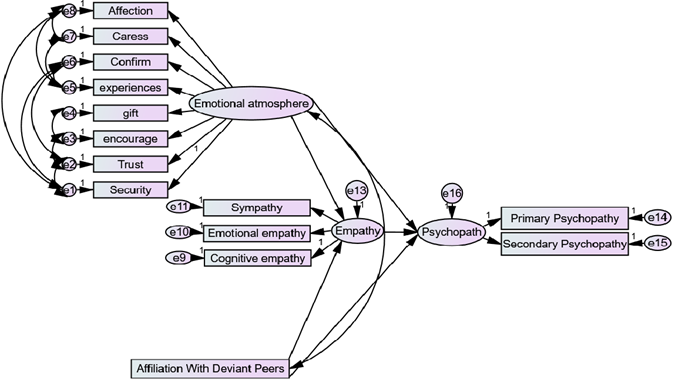
This cross-sectional study employed a correlational design. The sample consisted of 382 tenth- and eleventh-grade students (ages 15–17) selected through convenience sampling from high schools in Rasht during the second semester of 2023. Inclusion criteria were age, grade level, and willingness to participate, while incomplete questionnaires were excluded. Data were collected using the Levenson Self-Report Psychopathy Scale (1995), the Family Emotional Atmosphere Questionnaire (Bern, 1964), the Adolescent Affiliation with Deviant Peers Scale (Paschal et al., 2003), and the Adolescent Measure of Empathy and Sympathy (Vossen et al., 2015). These instruments have established reliability and validity. Data analysis was performed using path analysis within the structural equation modeling framework
Findings
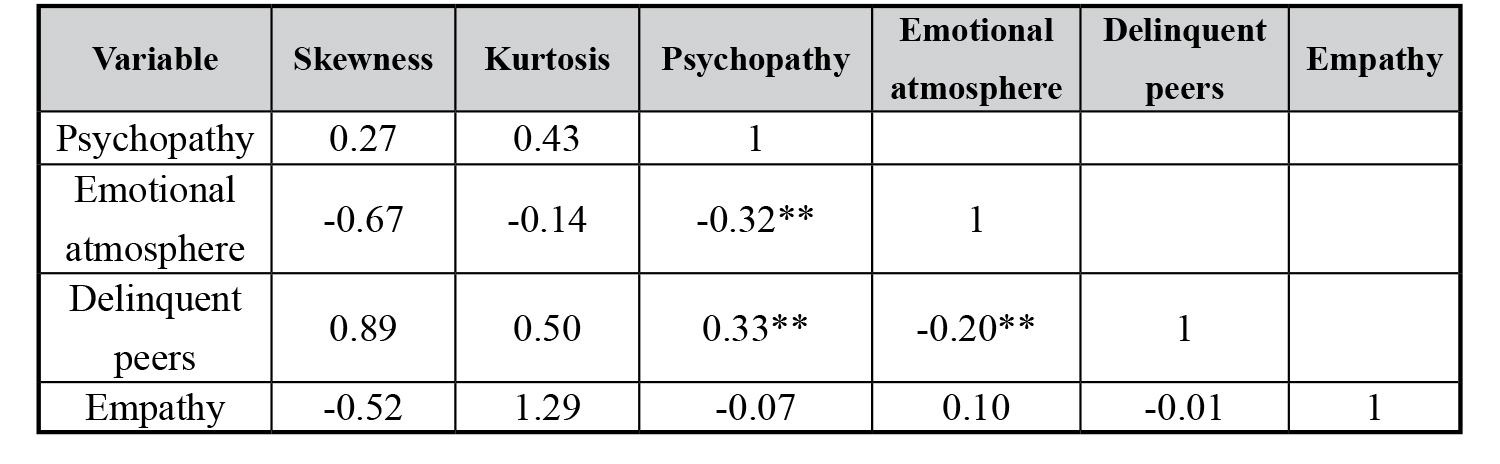
In Table 1, the values of kurtosis, skewness and correlation of the variables under study are reported. Given the skewness and kurtosis values of less than ±2, the distribution of variables in students is normal.
Table 1- Kurtosis, skewness and correlation relationship between research variables
Structural equation modeling (path analysis) tested the mediating role of empathy in relationships between family emotional atmosphere and delinquent peer affiliation with psychopathic personality in adolescents. The corrected model showed good fit (Table 2).
Table 2- Model fit indices for the mediating role of empathy

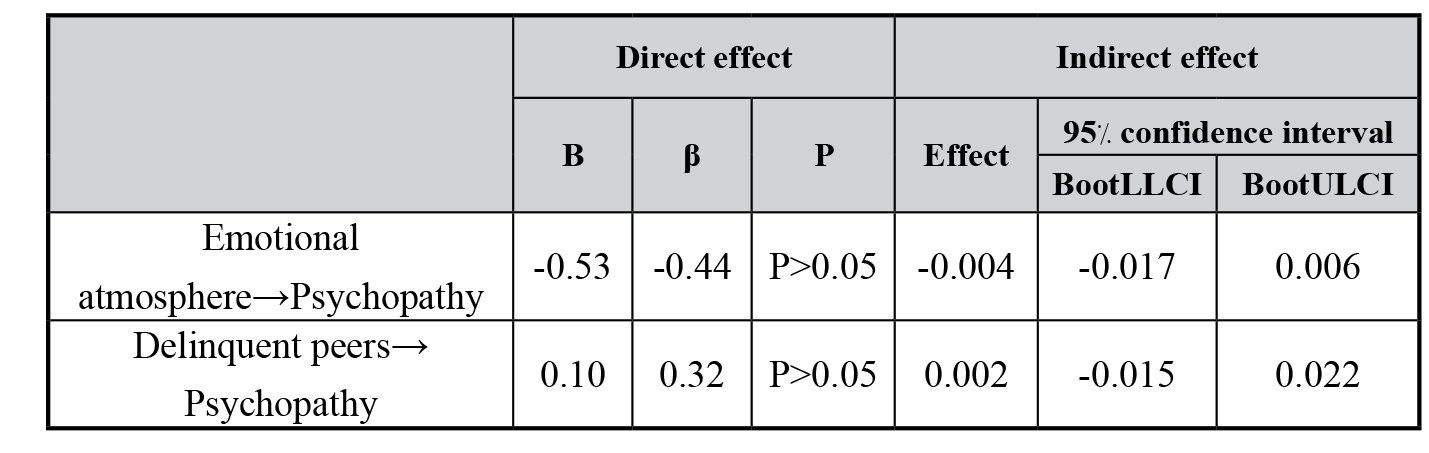
Table 3 presents the direct and indirect paths of the research model. Findings indicate that family emotional atmosphere has a significant inverse relationship with psychopathy (β = –0.53), while affiliation with delinquent peers shows a direct relationship with psychopathy (β = 0.10). Moreover, since the indirect effects in both paths fell within the confidence interval bounds, empathy was confirmed as a mediating variable in the relationship of both family emotional atmosphere and affiliation with delinquent peers with psychopathy
Table 3 - Examination of direct and indirect paths
Discussion
The findings show that a negative family emotional atmosphere is inversely related to adolescent psychopathy. Such an atmosphere can create feelings of rejection and loneliness, hinder problem-solving and emotion regulation, and increase vulnerability to antisocial behavior. Moreover, parents with psychopathic traits may directly model these behaviors for their children.
Results also highlight empathy as a mediating factor. A negative family atmosphere can weaken empathy, making adolescents indifferent to others’ emotions and more prone to violent or antisocial acts. Conversely, poor empathy may further deteriorate family interactions, intensifying psychopathic traits.
ffiliation with delinquent peers was positively associated with psychopathic traits. Adolescence constitutes a critical period for identity formation, during which peer influence is particularly potent. Associations with delinquent groups can normalize antisocial behaviors and foster a maladaptive sense of belonging. Consistent with social learning theory, adolescents may internalize and replicate these undesirable behaviors through observation and imitation of their peers.
Empathy again emerged as a mediator in this relationship. Deficits in empathy may drive adolescents toward peers with similar traits, creating bonds based on similarity rather than depth. Such ties can reinforce unempathetic or even exploitative behaviors, increasing the risk of psychopathy.
Overall, both family emotional atmosphere and delinquent peer affiliation are key determinants of psychopathic tendencies in adolescents. Supportive families can foster empathy, thereby reducing susceptibility to delinquent influences. Even when exposed to deviant peers, adolescents with higher empathy are less likely to engage in psychopathic behaviors.
This study has certain limitations, including its reliance on self-report measures and a convenience sampling method. Despite these limitations, the findings highlight the critical importance of preventive interventions focused on strengthening the family emotional climate, monitoring adolescent peer relationships, and fostering empathy. Specifically, family-based programs should aim to improve parent-child bonds and teach effective parental monitoring skills. Concurrently, school-based interventions can promote empathy through techniques such as role-playing and perspective-taking exercises.
Ethical Considerations
Approved by the Biomedical Ethics Committee, University of Guilan (Code: ETHICS-2402-1087). Participation was voluntary with informed consent and confidentiality assured.
Conflict of Interest: None declared.
Funding: No external funding
Type of Study: orginal |
Received: 2024/11/30 | Accepted: 2025/09/6 | Published: 2025/10/4
Received: 2024/11/30 | Accepted: 2025/09/6 | Published: 2025/10/4
Send email to the article author
| Rights and permissions | |
 |
This work is licensed under a Creative Commons Attribution-NonCommercial 4.0 International License. |

Contact Information
Copyright © The Author(s);
This is an open access article distributed under the terms of the Creative Commons Attribution-NonCommercial 4.0 (CC-By-NC 4.0), which permits use, distribution, and reproduction in any medium, provided the original work is properly cited and is not used for commercial purposes.
Contact Information
