

Volume 26, Issue 1 (4-2026)
Social Welfare Quarterly 2026, 26(1): 129-156 |
Back to browse issues page



Download citation:
BibTeX | RIS | EndNote | Medlars | ProCite | Reference Manager | RefWorks
Send citation to:


BibTeX | RIS | EndNote | Medlars | ProCite | Reference Manager | RefWorks
Send citation to:
Shakerizadeh haghighi F, Arshi M, Sabzi Khoshnami M. (2026). Social Workers’ Experiences of Working with Adolescents Who Attempted Suicide in Public Hospitals: A Qualitative Study. Social Welfare Quarterly. 26(1), 129-156. doi:10.32598/refahj.26.100.3
URL: http://refahj.uswr.ac.ir/article-1-4479-en.html
URL: http://refahj.uswr.ac.ir/article-1-4479-en.html

Full-Text [PDF 535 kb]
(399 Downloads)
| Abstract (HTML) (1692 Views)
Full-Text: (31 Views)
Extended Abstract
Introduction
Adolescent suicide poses a serious challenge to mental and social health systems due to the unique developmental vulnerabilities of this age group, including stress and identity crises. It results in significant psychological, social, and economic impacts worldwide (Hendershot & Foll, 2024; Leiner et al., 2025; Zhao et al., 2024). According to the World Health Organization, suicide is the third leading cause of death among individuals aged 15–29, with considerable economic costs such as healthcare expenses and lost productivity (Perlis & Fihn, 2020).
Method
This study was conducted using a conventional qualitative content analysis approach based on Graneheim and Lundman’s method to explore social workers’ interventions, experiences, challenges, and facilitators in working with adolescents who had attempted suicide. The research was carried out in selected medical centers across the country that had admitted at least 15 adolescents with suicide attempts within a three-month period. Data were collected over six months (January to June 2023).
After approval of the proposal and obtaining the ethics code (IR.USWR.REC.1401.213) from the University of Social Welfare and Rehabilitation Sciences, the study was implemented. All participants provided informed consent. Purposeful sampling with maximum variation was used, and participants included 16 social workers, 3 adolescents with a history of suicide attempts, and 2 family members. Data were collected through in-depth semi-structured interviews until data saturation was achieved and were analyzed through transcription, coding, categorization, and theme development. Trustworthiness was ensured using credibility, transferability, dependability, and confirmability criteria.
Findings
The participants consisted of 16 social workers (7 men and 9 women) with a mean age of 38.5 years, three adolescents who had attempted suicide, and two of their family members. Approximately 43% of the social workers held a bachelor’s degree, 43% held a master’s degree, and 12% held a PhD. The average work experience in social work was 12.5 years, with 10.6 years specifically in suicide-related cases. The adolescents had been hospitalized for an average of seven days, and most were first-time suicide attempters (Tables 1–3).
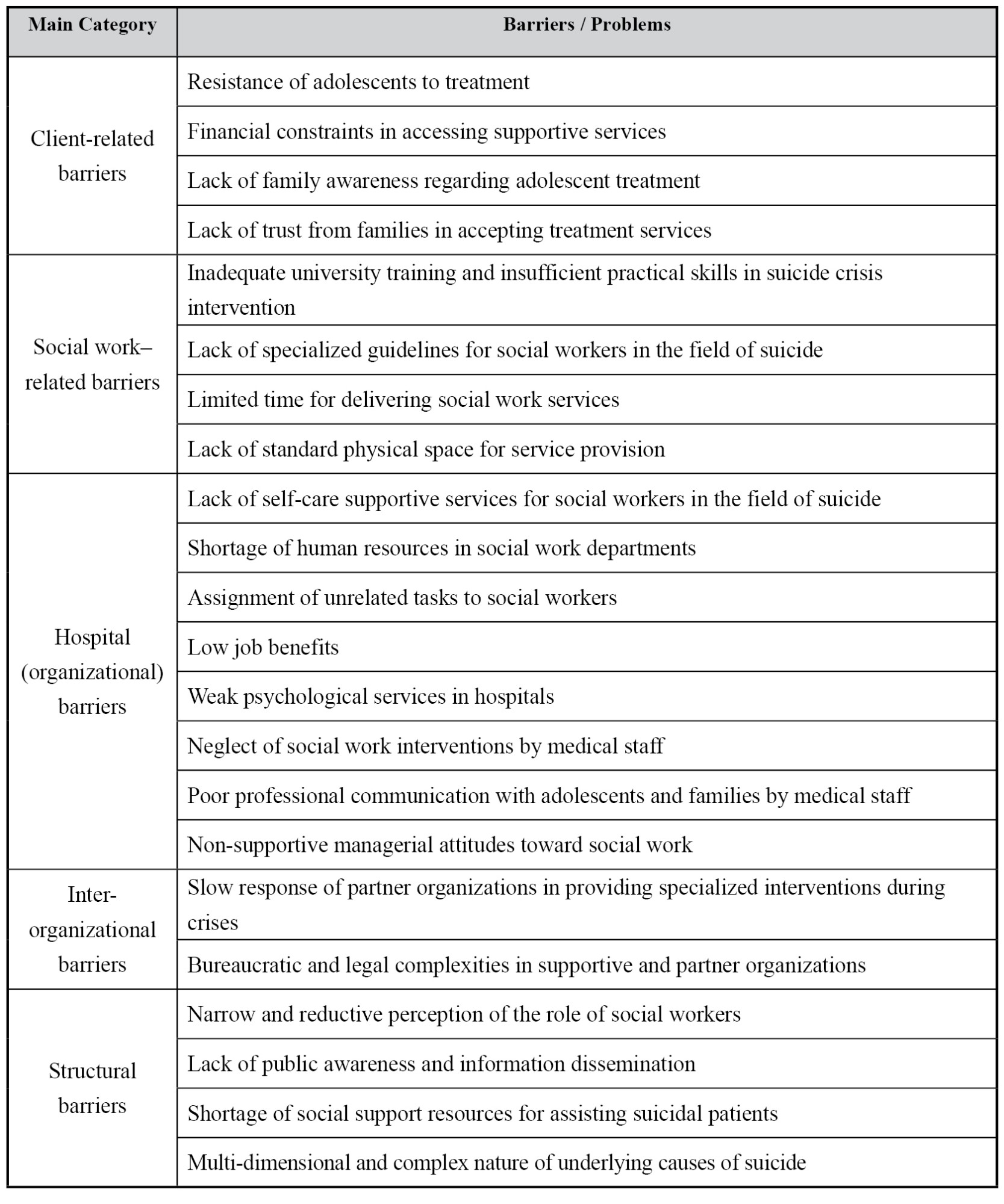
The findings revealed that barriers to social work interventions with adolescents who had attempted suicide were classified into five main categories: client-related barriers, social work–related barriers, hospital (organizational) barriers, inter-organizational barriers, and structural barriers. These categories comprised a total of 22 subcategories (Table 1).
Discussion
This study explored social workers’ experiences in working with adolescents with a history of suicide attempts. The analysis revealed multiple barriers at the client, professional, hospital, inter-organizational, and structural levels.
A major client-related barrier was resistance to treatment, linked to adolescence-specific identity challenges, autonomy-seeking, and cognitive changes, leading to mistrust of interventions. This aligns with McHolland (1985), who emphasized empathy, acceptance, and safe spaces—an approach also relevant in Iranian culture (McHolland, 1985).
Financial barriers were significant, as families often could not afford counseling and therapy. This finding is consistent with Steele, et ai. (2007), who reported greater service access problems among low-income groups, particularly in settings with weaker social support systems (Steele, et al. 2007).
Professional barriers included insufficient academic training and practical skills. Sung‐Chan and Yuen‐Tsang (2008) highlighted this gap and recommended “reciprocal reflection” to integrate theory and practice through shared experiential learning (Sung‐Chan & Yuen‐Tsang, 2008).
The lack of specialized guidelines forced social workers to rely on personal experience, creating inconsistent interventions and lower confidence. Both Robinson et al. (2018) and Nejad et al. (2019) stressed the need for standardized protocols (Robinson et al., 2018; Nejad et al., 2019).
Physical space limitations, such as the absence of private counseling rooms, compromised confidentiality and service quality—a concern also noted by Kalate Sadati et al. (2023) and Kim & Sung (2022).
The absence of supportive services and self-care programs for social workers negatively impacted mental health and job quality. Ratcliff (2024) and Wawrzonek (2023) confirmed the link between insufficient organizational support and burnout (Ratcliff, 2024; Wawrzonek, 2023).
Low pay, lack of incentives, and no hardship allowances reduced motivation, despite the emotionally demanding nature of this work. Similarly, the absence of permanent psychologists meant at-risk adolescents were discharged without proper psychological assessment, highlighting the need for multidisciplinary teams (NajafAbadi & Rezaeian, 2025).
Weak communication between healthcare staff, adolescents, and families left families uninformed about causes, treatment, and care processes, increasing stress and mistrust—findings also reported by NajafAbadi & Rezaeian (2025).
Hospital management’s superficial view of social work reduced intervention quality and motivation. Yalli & Albrithen (2011) and Kalate Sadati et al. (2023) stressed the role of supportive organizational structures (Yalli & Albrithen, 2011; Sadati et al., 2023).
Slow responses from collaborating agencies such as social emergency services limited timely support, echoing findings by Kalate Sadati (2023).
Finally, the shortage of social support resources—financial aid, employment services—restricted social workers’ capacity to address poverty-related suicide risk, consistent with Jones & Novak (2012). According to Engel’s (1977) biopsychosocial model, suicide arises from complex interactions between biological, psychological, and social factors. This study underscores the need for structural reforms, adequate resources, and integrated social strategies for effective prevention.
This study found that social work interventions with adolescents who attempted suicide face challenges at hospital, organizational, and societal levels. Addressing adolescent suicide requires coordinated efforts among hospitals, support agencies, and communities. Enhancing inter-agency collaboration, public awareness, structural support for social workers, and specialized training can improve outcomes and reduce suicide rates.
Policymakers should adopt evidence-based, comprehensive strategies to enable effective interventions. Future research could explore group therapy’s impact, family support roles, and educational program effectiveness. Suggested interventions include supervised self-help groups, specialized training for social workers, improved communication skills, and evidence-based methods.
While social workers encounter substantial barriers at individual, professional, organizational, and structural levels, the presence of facilitators such as professional expertise, support from the treatment team, and organizational capacity can improve the quality and effectiveness of interventions. Therefore, the following actions are recommended:
• Develop specialized guidelines for adolescent suicide intervention
• Strengthen intersectoral coordination among responsible agencies
• Empower social workers through targeted professional training
• Promote a supportive view of social work at managerial levels
• Expand family and adolescent education programs for prevention and rehabilitation
Ethical Considerations
Compliance With Ethical Guidelines
This study was approved by the Ethics Committee (Code: IR.USWR.REC.1401.213). Informed consent was obtained from all participants, and confidentiality was maintained.
Authors’ Contributions
All authors contributed to the study design, data analysis, manuscript preparation, and approved the final version.
Funding
This study was derived from a master’s thesis and received no specific funding.
Conflicts of Interest
The authors declare no conflict of interest.
Hendershot, C. S., & Foll, B. L. (2024). Substance Use and Concurrent Disorders: Current Context and the Need for Treatment Integration. In (pp. 07067437241305174): SAGE Publications Sage CA: Los Angeles, CA.
Jones, C., & Novak, T. (2012). Poverty, welfare and the disciplinary state: Routledge. https://doi.org/10.4324/9780203003664
Kim, U.-R., & Sung, H. (2022). Urban parks as a potential mitigator of suicide rates resulting from global pandemics: Empirical evidence from past experiences in Seoul, Korea. Cities, 127, 103725.
Leiner, M., de la Rosa, J. M., & de Vargas, C. (2025). The virtual kidnapping of youth by social media advertising. Journal of Pediatric and Neonatal Individualized Medicine (JPNIM), 14(1), e140105-e140105. https://doi.org/10.7363/140105
McHolland, J. D. (1985). Strategies for dealing with resistant adolescents. Adolescence, 20(78), 349.
NajafAbadi, R. S., & Rezaeian, M. (2025). In the Shadow of the Unsaid: A Qualitative Analysis of Barriers and Challenges in Suicide Prevention. Journal of Rafsanjan University of Medical Sciences, 23(9). (in persian)
Nejad, S., Homeira, Poursharifi, Mohammadzadeh, Jahansha, Miri, S., & Kourosh. (2019). The effectiveness of an integrative intervention on hopelessness and emotional dysregulation as determinants of suicidal tendencies in adolescents and young people in Ilam. Community Health, 13(3), 32-43. (in persian)
Norouzi, Vand, M., Khanke, & Aqlima. (2023). Investigating the emergence of barriers and facilitators of social work interventions towards couples’ sexual satisfaction. Quarterly Cultural-Educational Journal of Women and Family, 18(65), 161-184. (in persian)
Perlis, R. H., & Fihn, S. D. (2020). Hard truths about suicide prevention. JAMA network open, 3(10), e2022713-e2022713. doi: https://doi.org/10.1001/jamanetworkopen.2020.22713
Ratcliff, M. (2024). Social workers, burnout, and self-care: A public health issue. Delaware journal of public health, 10(1), 26. doi: https://doi.org/10.32481/djph.2024.03.05
Robinson, J., Bailey, E., Witt, K., Stefanac, N., Milner, A., Currier, D.,... Hetrick, S. (2018). What works in youth suicide prevention? A systematic review and meta-analysis. EClinicalMedicine, 4, 52-91. DOI: https://doi.org/10.1016/j.eclinm.2018.10.004
Sadati, K., Javadian, & Hardangi, S. (2023). Professional challenges of medical social work in safe patient discharge; a qualitative study. Hospital Quarterly, 22(3), 219-232. (in persian)
Steele, L., Dewa, C., & Lee, K. (2007). Socioeconomic status and self-reported barriers to mental health service use. The Canadian Journal of Psychiatry, 52(3), 201-206. DOI: https://doi.org/10.1177/070674370705200312
Sung‐Chan, P., & Yuen‐Tsang, A. (2008). Bridging the theory–practice gap in social work education: a reflection on an action research in China. Social Work Education, 27(1), 51-69. https://doi.org/10.1080/02615470601141383
Wawrzonek, J. (2023). Exploring Social Workers and Self-Care. Walden University,
Yalli, N., & Albrithen, A. (2011). The perceptions of the personal and professional factors influencing social workers in Saudi hospitals: a qualitative analysis. Social work in health care, 50(10), 845-862.
Zhao, X., Ma, H., Li, N., Wu, W., Ma, X., Zhang, X.,... Dong, H. (2024). Association between sleep disorder and anhedonia in adolescence with major depressive disorder: the mediating effect of stress. BMC psychiatry, 24(1), 962.
Introduction
Adolescent suicide poses a serious challenge to mental and social health systems due to the unique developmental vulnerabilities of this age group, including stress and identity crises. It results in significant psychological, social, and economic impacts worldwide (Hendershot & Foll, 2024; Leiner et al., 2025; Zhao et al., 2024). According to the World Health Organization, suicide is the third leading cause of death among individuals aged 15–29, with considerable economic costs such as healthcare expenses and lost productivity (Perlis & Fihn, 2020).
Method
This study was conducted using a conventional qualitative content analysis approach based on Graneheim and Lundman’s method to explore social workers’ interventions, experiences, challenges, and facilitators in working with adolescents who had attempted suicide. The research was carried out in selected medical centers across the country that had admitted at least 15 adolescents with suicide attempts within a three-month period. Data were collected over six months (January to June 2023).
After approval of the proposal and obtaining the ethics code (IR.USWR.REC.1401.213) from the University of Social Welfare and Rehabilitation Sciences, the study was implemented. All participants provided informed consent. Purposeful sampling with maximum variation was used, and participants included 16 social workers, 3 adolescents with a history of suicide attempts, and 2 family members. Data were collected through in-depth semi-structured interviews until data saturation was achieved and were analyzed through transcription, coding, categorization, and theme development. Trustworthiness was ensured using credibility, transferability, dependability, and confirmability criteria.
Findings
The participants consisted of 16 social workers (7 men and 9 women) with a mean age of 38.5 years, three adolescents who had attempted suicide, and two of their family members. Approximately 43% of the social workers held a bachelor’s degree, 43% held a master’s degree, and 12% held a PhD. The average work experience in social work was 12.5 years, with 10.6 years specifically in suicide-related cases. The adolescents had been hospitalized for an average of seven days, and most were first-time suicide attempters (Tables 1–3).
The findings revealed that barriers to social work interventions with adolescents who had attempted suicide were classified into five main categories: client-related barriers, social work–related barriers, hospital (organizational) barriers, inter-organizational barriers, and structural barriers. These categories comprised a total of 22 subcategories (Table 1).
Discussion
This study explored social workers’ experiences in working with adolescents with a history of suicide attempts. The analysis revealed multiple barriers at the client, professional, hospital, inter-organizational, and structural levels.
A major client-related barrier was resistance to treatment, linked to adolescence-specific identity challenges, autonomy-seeking, and cognitive changes, leading to mistrust of interventions. This aligns with McHolland (1985), who emphasized empathy, acceptance, and safe spaces—an approach also relevant in Iranian culture (McHolland, 1985).
Financial barriers were significant, as families often could not afford counseling and therapy. This finding is consistent with Steele, et ai. (2007), who reported greater service access problems among low-income groups, particularly in settings with weaker social support systems (Steele, et al. 2007).
Professional barriers included insufficient academic training and practical skills. Sung‐Chan and Yuen‐Tsang (2008) highlighted this gap and recommended “reciprocal reflection” to integrate theory and practice through shared experiential learning (Sung‐Chan & Yuen‐Tsang, 2008).
The lack of specialized guidelines forced social workers to rely on personal experience, creating inconsistent interventions and lower confidence. Both Robinson et al. (2018) and Nejad et al. (2019) stressed the need for standardized protocols (Robinson et al., 2018; Nejad et al., 2019).
Physical space limitations, such as the absence of private counseling rooms, compromised confidentiality and service quality—a concern also noted by Kalate Sadati et al. (2023) and Kim & Sung (2022).
The absence of supportive services and self-care programs for social workers negatively impacted mental health and job quality. Ratcliff (2024) and Wawrzonek (2023) confirmed the link between insufficient organizational support and burnout (Ratcliff, 2024; Wawrzonek, 2023).
Low pay, lack of incentives, and no hardship allowances reduced motivation, despite the emotionally demanding nature of this work. Similarly, the absence of permanent psychologists meant at-risk adolescents were discharged without proper psychological assessment, highlighting the need for multidisciplinary teams (NajafAbadi & Rezaeian, 2025).
Weak communication between healthcare staff, adolescents, and families left families uninformed about causes, treatment, and care processes, increasing stress and mistrust—findings also reported by NajafAbadi & Rezaeian (2025).
Hospital management’s superficial view of social work reduced intervention quality and motivation. Yalli & Albrithen (2011) and Kalate Sadati et al. (2023) stressed the role of supportive organizational structures (Yalli & Albrithen, 2011; Sadati et al., 2023).
Slow responses from collaborating agencies such as social emergency services limited timely support, echoing findings by Kalate Sadati (2023).
Finally, the shortage of social support resources—financial aid, employment services—restricted social workers’ capacity to address poverty-related suicide risk, consistent with Jones & Novak (2012). According to Engel’s (1977) biopsychosocial model, suicide arises from complex interactions between biological, psychological, and social factors. This study underscores the need for structural reforms, adequate resources, and integrated social strategies for effective prevention.
This study found that social work interventions with adolescents who attempted suicide face challenges at hospital, organizational, and societal levels. Addressing adolescent suicide requires coordinated efforts among hospitals, support agencies, and communities. Enhancing inter-agency collaboration, public awareness, structural support for social workers, and specialized training can improve outcomes and reduce suicide rates.
Policymakers should adopt evidence-based, comprehensive strategies to enable effective interventions. Future research could explore group therapy’s impact, family support roles, and educational program effectiveness. Suggested interventions include supervised self-help groups, specialized training for social workers, improved communication skills, and evidence-based methods.
While social workers encounter substantial barriers at individual, professional, organizational, and structural levels, the presence of facilitators such as professional expertise, support from the treatment team, and organizational capacity can improve the quality and effectiveness of interventions. Therefore, the following actions are recommended:
• Develop specialized guidelines for adolescent suicide intervention
• Strengthen intersectoral coordination among responsible agencies
• Empower social workers through targeted professional training
• Promote a supportive view of social work at managerial levels
• Expand family and adolescent education programs for prevention and rehabilitation
Ethical Considerations
Compliance With Ethical Guidelines
This study was approved by the Ethics Committee (Code: IR.USWR.REC.1401.213). Informed consent was obtained from all participants, and confidentiality was maintained.
Authors’ Contributions
All authors contributed to the study design, data analysis, manuscript preparation, and approved the final version.
Funding
This study was derived from a master’s thesis and received no specific funding.
Conflicts of Interest
The authors declare no conflict of interest.
Hendershot, C. S., & Foll, B. L. (2024). Substance Use and Concurrent Disorders: Current Context and the Need for Treatment Integration. In (pp. 07067437241305174): SAGE Publications Sage CA: Los Angeles, CA.
Jones, C., & Novak, T. (2012). Poverty, welfare and the disciplinary state: Routledge. https://doi.org/10.4324/9780203003664
Kim, U.-R., & Sung, H. (2022). Urban parks as a potential mitigator of suicide rates resulting from global pandemics: Empirical evidence from past experiences in Seoul, Korea. Cities, 127, 103725.
Leiner, M., de la Rosa, J. M., & de Vargas, C. (2025). The virtual kidnapping of youth by social media advertising. Journal of Pediatric and Neonatal Individualized Medicine (JPNIM), 14(1), e140105-e140105. https://doi.org/10.7363/140105
McHolland, J. D. (1985). Strategies for dealing with resistant adolescents. Adolescence, 20(78), 349.
NajafAbadi, R. S., & Rezaeian, M. (2025). In the Shadow of the Unsaid: A Qualitative Analysis of Barriers and Challenges in Suicide Prevention. Journal of Rafsanjan University of Medical Sciences, 23(9). (in persian)
Nejad, S., Homeira, Poursharifi, Mohammadzadeh, Jahansha, Miri, S., & Kourosh. (2019). The effectiveness of an integrative intervention on hopelessness and emotional dysregulation as determinants of suicidal tendencies in adolescents and young people in Ilam. Community Health, 13(3), 32-43. (in persian)
Norouzi, Vand, M., Khanke, & Aqlima. (2023). Investigating the emergence of barriers and facilitators of social work interventions towards couples’ sexual satisfaction. Quarterly Cultural-Educational Journal of Women and Family, 18(65), 161-184. (in persian)
Perlis, R. H., & Fihn, S. D. (2020). Hard truths about suicide prevention. JAMA network open, 3(10), e2022713-e2022713. doi: https://doi.org/10.1001/jamanetworkopen.2020.22713
Ratcliff, M. (2024). Social workers, burnout, and self-care: A public health issue. Delaware journal of public health, 10(1), 26. doi: https://doi.org/10.32481/djph.2024.03.05
Robinson, J., Bailey, E., Witt, K., Stefanac, N., Milner, A., Currier, D.,... Hetrick, S. (2018). What works in youth suicide prevention? A systematic review and meta-analysis. EClinicalMedicine, 4, 52-91. DOI: https://doi.org/10.1016/j.eclinm.2018.10.004
Sadati, K., Javadian, & Hardangi, S. (2023). Professional challenges of medical social work in safe patient discharge; a qualitative study. Hospital Quarterly, 22(3), 219-232. (in persian)
Steele, L., Dewa, C., & Lee, K. (2007). Socioeconomic status and self-reported barriers to mental health service use. The Canadian Journal of Psychiatry, 52(3), 201-206. DOI: https://doi.org/10.1177/070674370705200312
Sung‐Chan, P., & Yuen‐Tsang, A. (2008). Bridging the theory–practice gap in social work education: a reflection on an action research in China. Social Work Education, 27(1), 51-69. https://doi.org/10.1080/02615470601141383
Wawrzonek, J. (2023). Exploring Social Workers and Self-Care. Walden University,
Yalli, N., & Albrithen, A. (2011). The perceptions of the personal and professional factors influencing social workers in Saudi hospitals: a qualitative analysis. Social work in health care, 50(10), 845-862.
Zhao, X., Ma, H., Li, N., Wu, W., Ma, X., Zhang, X.,... Dong, H. (2024). Association between sleep disorder and anhedonia in adolescence with major depressive disorder: the mediating effect of stress. BMC psychiatry, 24(1), 962.
Type of Study: orginal |
Received: 2025/06/7 | Accepted: 2026/05/5 | Published: 2026/05/31
Received: 2025/06/7 | Accepted: 2026/05/5 | Published: 2026/05/31
Send email to the article author
| Rights and permissions | |
 |
This work is licensed under a Creative Commons Attribution-NonCommercial 4.0 International License. |

Contact Information
Copyright © The Author(s);
This is an open access article distributed under the terms of the Creative Commons Attribution-NonCommercial 4.0 (CC-By-NC 4.0), which permits use, distribution, and reproduction in any medium, provided the original work is properly cited and is not used for commercial purposes.
Contact Information
