

Volume 25, Issue 99 (1-2026)
Social Welfare Quarterly 2026, 25(99): 9-38 |
Back to browse issues page



Ethics code:


Download citation:
BibTeX | RIS | EndNote | Medlars | ProCite | Reference Manager | RefWorks
Send citation to:


BibTeX | RIS | EndNote | Medlars | ProCite | Reference Manager | RefWorks
Send citation to:
Talebzadeh M, Babaki R, Elyaspour B. (2026). The Effect of Economic Freedom on the Health Index (A Cross Country Comparison). Social Welfare Quarterly. 25(99), 9-38. doi:10.32598/refahj.25.99.4685.1
URL: http://refahj.uswr.ac.ir/article-1-4473-en.html
URL: http://refahj.uswr.ac.ir/article-1-4473-en.html

Full-Text [PDF 598 kb]
(546 Downloads)
| Abstract (HTML) (1456 Views)
Full-Text: (313 Views)
Introduction
The significance of the health index lies in its role in achieving human development. Health is an essential and inseparable part of life, influenced by a variety of factors, including individual and social determinants. Among individual factors are GDP per capita and Information and Communication Technology (ICT), while social factors include urbanization and economic freedom. This study examines both individual and social factors in two groups of East and West Asian countries using a panel data model. Accordingly, the objectives of this study are:
A. To investigate the effect of ICT on the health index in selected countries in East and West Asia.
B. To examine the effect of economic freedom on the health index in selected countries in East and West Asia.
Method
The empirical model used in this study is based on Hall et al. (2018) and is specified as follows:
Hit=f(ICTit,EFit,RGDPit,UPit,HEit,ICTit*EFit)
Where:
Hit: Under-5 Mortality Rate (U5MR)
ICTit: Information and Communication Technology Development Index
EFit: Economic Freedom Index
RGDPit: GDP Growth (annual %)
UPit: Urbanization Rate (% of total population)
HEit: Government Domestic Public Health Expenditure (% of total government expenditure)
ICTit*EFit: Interaction term of ICT and economic freedom
i=1,2,…,N: Number of countries
t=1,2,…,T: Time period
αi: Country-specific effects
ϵit: Error term
Before estimating the final model, diagnostic tests were conducted, including cross-sectional dependence, unit root, cointegration, F-Limer, and Hausman tests. Results indicated no cross-sectional dependence, so first-generation unit root tests (Levine, Lin, and Chu) were applied. Some variables were stationary at levels, while others required first differences. The Kao cointegration test confirmed the existence of a long-term relationship among the model variables for both East and West Asian countries. The F-Limer test indicated that the data are suitable for panel modeling, and the Hausman test suggested the use of a fixed effects model for final estimation.
Findings
Before estimating the final panel data model, several diagnostic tests were performed, including cross-sectional dependence, unit root, cointegration, F-Limer, and Hausman tests. The results indicated no cross-sectional dependence, allowing the use of first-generation unit root tests such as Levine, Lin, and Chu. The unit root tests showed that some variables were stationary at levels, while others became stationary after first differencing. To examine long-term relationships among the model variables, the Kao cointegration test was conducted, confirming the existence of cointegration for both East and West Asian countries. The F-Limer test indicated that the data were suitable for panel modeling, and the Hausman test suggested the use of the fixed effects method for final estimation. Following these diagnostic tests, the final model was estimated.
The significance of the health index lies in its role in achieving human development. Health is an essential and inseparable part of life, influenced by a variety of factors, including individual and social determinants. Among individual factors are GDP per capita and Information and Communication Technology (ICT), while social factors include urbanization and economic freedom. This study examines both individual and social factors in two groups of East and West Asian countries using a panel data model. Accordingly, the objectives of this study are:
A. To investigate the effect of ICT on the health index in selected countries in East and West Asia.
B. To examine the effect of economic freedom on the health index in selected countries in East and West Asia.
Method
The empirical model used in this study is based on Hall et al. (2018) and is specified as follows:
Hit=f(ICTit,EFit,RGDPit,UPit,HEit,ICTit*EFit)
Where:
Hit: Under-5 Mortality Rate (U5MR)
ICTit: Information and Communication Technology Development Index
EFit: Economic Freedom Index
RGDPit: GDP Growth (annual %)
UPit: Urbanization Rate (% of total population)
HEit: Government Domestic Public Health Expenditure (% of total government expenditure)
ICTit*EFit: Interaction term of ICT and economic freedom
i=1,2,…,N: Number of countries
t=1,2,…,T: Time period
αi: Country-specific effects
ϵit: Error term
Before estimating the final model, diagnostic tests were conducted, including cross-sectional dependence, unit root, cointegration, F-Limer, and Hausman tests. Results indicated no cross-sectional dependence, so first-generation unit root tests (Levine, Lin, and Chu) were applied. Some variables were stationary at levels, while others required first differences. The Kao cointegration test confirmed the existence of a long-term relationship among the model variables for both East and West Asian countries. The F-Limer test indicated that the data are suitable for panel modeling, and the Hausman test suggested the use of a fixed effects model for final estimation.
Findings
Before estimating the final panel data model, several diagnostic tests were performed, including cross-sectional dependence, unit root, cointegration, F-Limer, and Hausman tests. The results indicated no cross-sectional dependence, allowing the use of first-generation unit root tests such as Levine, Lin, and Chu. The unit root tests showed that some variables were stationary at levels, while others became stationary after first differencing. To examine long-term relationships among the model variables, the Kao cointegration test was conducted, confirming the existence of cointegration for both East and West Asian countries. The F-Limer test indicated that the data were suitable for panel modeling, and the Hausman test suggested the use of the fixed effects method for final estimation. Following these diagnostic tests, the final model was estimated.
Results of Model Estimation
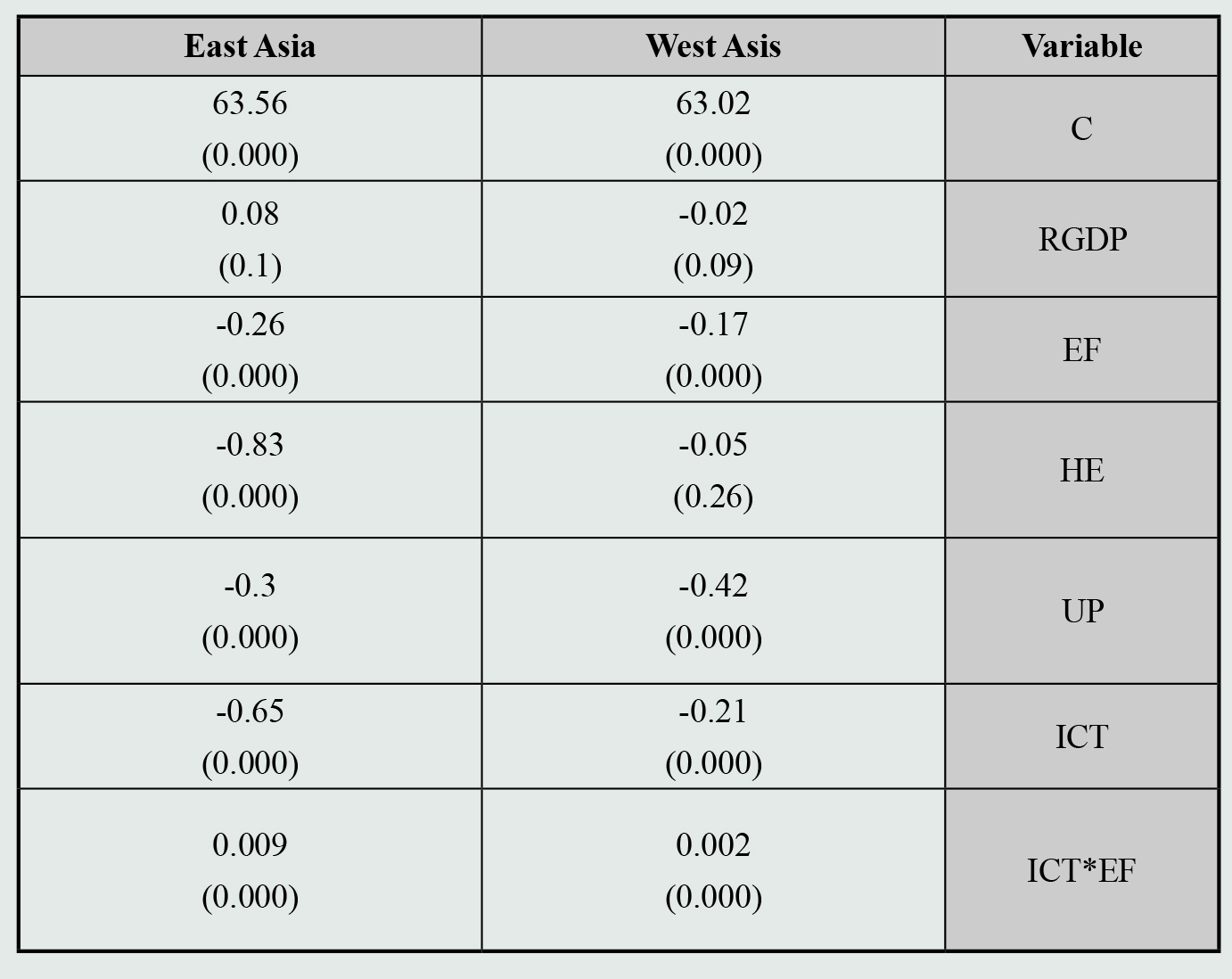
The results indicate that economic freedom has a positive and significant effect on the health index. In East and West Asian countries, a one-unit increase in economic freedom reduces under-five mortality by 0.26 and 0.17 units, respectively, reflecting an improvement in the health index. Thus, implementing economic freedom principles, facilitating cross-border cooperation, and leveraging expertise in the health sector can enhance health outcomes and reduce child mortality.
Discussion
Information and Communication Technology (ICT), measured by the number of people with internet access, also has a positive and significant effect. In East and West Asia, a one-unit increase in ICT reduces under-five mortality by 0.65 and 0.21 units, respectively, improving the health index. ICT enhances access to health knowledge, skills, and services, addressing health literacy challenges and facilitating better healthcare delivery, thereby reducing costs and improving health indicators.
The ICTEF interaction term represents the combined effect of ICT and economic freedom. In East and West Asia, a one-unit increase in this variable slightly increases under-five mortality by 0.009 and 0.002 units, respectively. Following Hall et al. (2018), the net effect of ICTEF is calculated as:
The net effect for East and West Asia is -0.056 and -0.082, respectively. The weak net effect may reflect the lack of coordinated ICT and economic freedom policies, as well as the slower pace of institutional reforms relative to rapid technological advancement. Nonetheless, the negative net effect suggests that integrating economic freedom into ICT-health policies could further reduce under-five mortality and improve health outcomes.
The estimation results show that both ICT development and economic freedom positively contribute to reducing under-five mortality, confirming their importance in addressing child health. Policies to reduce under-five mortality in Asia should prioritize ICT financing and its application in healthcare, alongside promoting economic freedom. In a free economy, ICT strengthens existing health systems and drives structural improvements in the health sector. Therefore, Asian countries, including Iran, should eliminate special privileges and monopolies, expand economic freedom, and leverage ICT in the health sector to improve the health index and achieve better health outcomes.
Ethical Consideration
Authors’ contributions: All authors made significant contributions to this study.
Funding: This research has not received any funding or financial support.
Conflicts of interest: There was no conflict of interest among the authors in this article .
Discussion
Information and Communication Technology (ICT), measured by the number of people with internet access, also has a positive and significant effect. In East and West Asia, a one-unit increase in ICT reduces under-five mortality by 0.65 and 0.21 units, respectively, improving the health index. ICT enhances access to health knowledge, skills, and services, addressing health literacy challenges and facilitating better healthcare delivery, thereby reducing costs and improving health indicators.
The ICTEF interaction term represents the combined effect of ICT and economic freedom. In East and West Asia, a one-unit increase in this variable slightly increases under-five mortality by 0.009 and 0.002 units, respectively. Following Hall et al. (2018), the net effect of ICTEF is calculated as:
The net effect for East and West Asia is -0.056 and -0.082, respectively. The weak net effect may reflect the lack of coordinated ICT and economic freedom policies, as well as the slower pace of institutional reforms relative to rapid technological advancement. Nonetheless, the negative net effect suggests that integrating economic freedom into ICT-health policies could further reduce under-five mortality and improve health outcomes.
The estimation results show that both ICT development and economic freedom positively contribute to reducing under-five mortality, confirming their importance in addressing child health. Policies to reduce under-five mortality in Asia should prioritize ICT financing and its application in healthcare, alongside promoting economic freedom. In a free economy, ICT strengthens existing health systems and drives structural improvements in the health sector. Therefore, Asian countries, including Iran, should eliminate special privileges and monopolies, expand economic freedom, and leverage ICT in the health sector to improve the health index and achieve better health outcomes.
Ethical Consideration
Authors’ contributions: All authors made significant contributions to this study.
Funding: This research has not received any funding or financial support.
Conflicts of interest: There was no conflict of interest among the authors in this article .
Hall, J.C., and Lawson, R.A. (2014). Economic freedom of the world: an accounting of the literature. Contemporary Economic Policy, 32(1), 1-19. https://onlinelibrary.wiley.com/doi/abs/10.1111/coep.12010
Type of Study: orginal |
Received: 2025/05/18 | Accepted: 2025/11/1 | Published: 2026/01/27
Received: 2025/05/18 | Accepted: 2025/11/1 | Published: 2026/01/27
Send email to the article author
| Rights and permissions | |
 |
This work is licensed under a Creative Commons Attribution-NonCommercial 4.0 International License. |

Contact Information
Copyright © The Author(s);
This is an open access article distributed under the terms of the Creative Commons Attribution-NonCommercial 4.0 (CC-By-NC 4.0), which permits use, distribution, and reproduction in any medium, provided the original work is properly cited and is not used for commercial purposes.
Contact Information
