

Volume 25, Issue 98 (10-2025)
Social Welfare Quarterly 2025, 25(98): 125-166 |
Back to browse issues page




Download citation:
BibTeX | RIS | EndNote | Medlars | ProCite | Reference Manager | RefWorks
Send citation to:


BibTeX | RIS | EndNote | Medlars | ProCite | Reference Manager | RefWorks
Send citation to:
Habibpour Gatabi K. (2025). Analysis of Social Participation among Iranian Youth. Social Welfare Quarterly. 25(98), 125-166. doi:10.32598/refahj.25.98.622.3
URL: http://refahj.uswr.ac.ir/article-1-4469-en.html
URL: http://refahj.uswr.ac.ir/article-1-4469-en.html

Full-Text [PDF 647 kb]
(1103 Downloads)
| Abstract (HTML) (1933 Views)
Full-Text: (995 Views)
Introduction
Given the necessity of youth social participation in achieving development, the present study seeks to answer these questions: What is the current status of youth social participation in various domains, dimensions, components, and indicators, and what are the differences between different social groups of youth in terms of elements of social participation?
Method
The statistical population of the study included all youth aged 18 to 35 years living in urban areas of the provincial centers of the country. Out of the total 31 provinces of the country, using the zoning of the provinces according to a combination of criteria of development level and cultural differences, including ethnicity, language, and religion, 15 provinces (provincial centers) were selected as the survey territory and sample. To select the sample size, 4,000 people were selected as a sample using the Cochran formula. To access the sample individuals at the level of selected areas and provinces, a combination of multi-stage cluster, stratified and availability sampling methods was used. Also, in terms of operationalization, the social participation construct in this study was measured and examined in two domains of subjective social participation and objective social participation with a combination of related elements and items.
Findings
This study yielded several main findings regarding the social participation of the country’s youth:
1- The context of the statistical sample of the study
The proportion of male youth (50.4%) was higher than that of female youth (49.6%). Most of them (43.8%) were between the ages of 29 and 35, and youth between the ages of 22 and 28 (39.2%) and 18 and 21 (17%) accounted for the next highest proportions of the sample youth in this study, respectively. More than half (61.2%) of the youth studied in this study were single and more than one-third (35.8%) were married. More than one-third of the sample youth in this study (39.8%) had a bachelor’s degree. In other words, two-thirds (66.7%) of the respondents had a university education and one-third (33.3%) had non-university education. Nearly half of them (45%) were of Persian ethnicity, followed by Azari/Turk (17%), Kurd (14.1%), and Lor (10.1%) in terms of the largest ethnic population. The majority of the study sample was Shia (87.3%). 11.7% of the sample was Sunni and 1.1% was from religious minorities. One-third (33.6%) of the youth sample in this study were employed full-time and 22.2% were employed part-time. Youth who were students (15.7%), housewives (10.7%), and unemployed and looking for work (10.4%) accounted for the next largest proportions of respondents in terms of employment status. In short, more than half of the youth were employed (55.8%) and 44.2% were unemployed. More than two-thirds of employed youth (71.1%) worked in private and freelance jobs, 16.4% in government and 12.5% in semi-government jobs. The average monthly family income among most of the youth studied in this study (39.1%) was 10 million Tomans or less, and the average income of a quarter of them (25.9%) was between 10.1 and 15 million Tomans. More than half of the youth (38.1%) described themselves as belonging to the lower middle class and 31.8% to the upper middle class. 35.4% of the respondents were in the lower economic and social class and 30.5% were in the upper class.
2- National identity
A strong sense of national pride is prevalent among Iranian youth, with more than half (52.7%) expressing that they are very proud to be Iranian, and a quarter (26%) reporting being somewhat proud. Regarding life satisfaction, 65% of the sampled youth indicated they are somewhat satisfied with life in Iran. The desire of young people to emigrate abroad (if the opportunity and conditions are available) is high. A significant majority of young people (71.5%) expressed that they would emigrate to another country if given the opportunity.
3- Following national issues and problems
39.8% of young people follow national issues and problems to a low degree, while 30.7% follow national issues and problems to a high degree.
4- Using the Internet and cyberspace
The majority of Iranian youth (28%) reported using the internet for 2 hours or less per day, while 27% reported usage of 3 to 4 hours daily. Additionally, the average daily internet usage among all surveyed youth was 5.5 hours.
5- Social participation
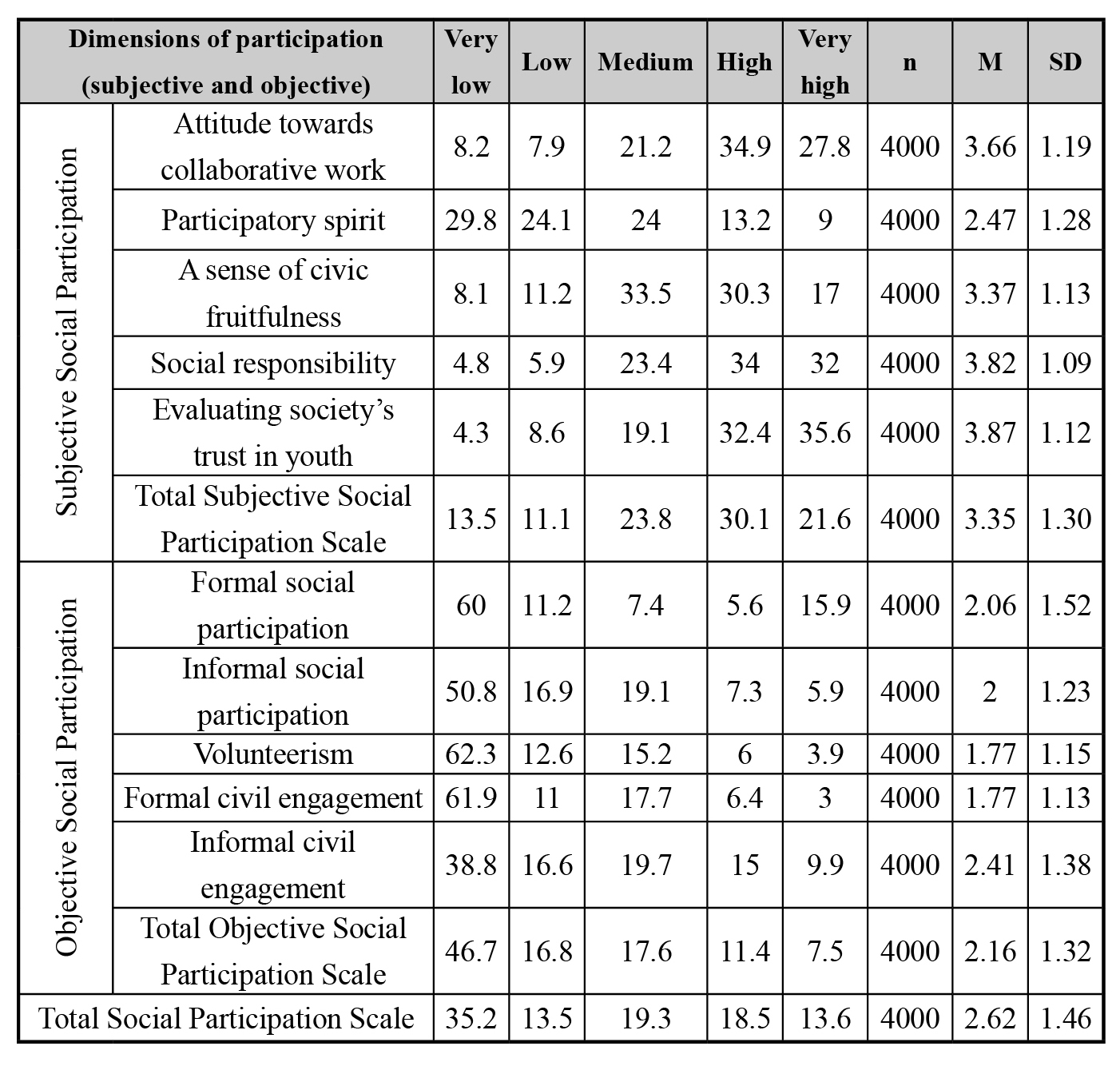
The overall level of social participation among young people is low. As about half of them (48.7%) had low social participation, and social participation was high among 32.1%.
5-1- Subjective social participation
The level of subjective social participation among young people is high. As more than half of them (51.7%) had high level of subjective social participation and a quarter (24.5%) had low level of subjective social participation.
5-2- Objective social participation
The level of objective social participation of young people is low. As more than two-thirds of them (68.2%) had low level of objective social participation and only 14.8% had high level of objective social participation.
5-3- Comparison of dimensions of social participation among young people
The level of subjective social participation of young people is higher than their objective social participation.
Discussion
The findings indicate that despite the low level of social participation among different groups of youth, and at the same time, their objective participation lags behind their subjective participation, the extent of this participation has a diverse pattern, and variables such as gender, employment status, type of employment, class, and the level of development of the province determine its scope.
Ethical considerations
Financial resources
This article was written independently and no financial support was received from any organization to write it.
Contribution of authors
The article is written by a single author.
Conflict of interest
According to the author, there is no conflict of interest in this article.
Follow the principles of research ethics
The author has complied all the ethical points, especially the non-manipulation and distortion of data in this article.
Given the necessity of youth social participation in achieving development, the present study seeks to answer these questions: What is the current status of youth social participation in various domains, dimensions, components, and indicators, and what are the differences between different social groups of youth in terms of elements of social participation?
Method
The statistical population of the study included all youth aged 18 to 35 years living in urban areas of the provincial centers of the country. Out of the total 31 provinces of the country, using the zoning of the provinces according to a combination of criteria of development level and cultural differences, including ethnicity, language, and religion, 15 provinces (provincial centers) were selected as the survey territory and sample. To select the sample size, 4,000 people were selected as a sample using the Cochran formula. To access the sample individuals at the level of selected areas and provinces, a combination of multi-stage cluster, stratified and availability sampling methods was used. Also, in terms of operationalization, the social participation construct in this study was measured and examined in two domains of subjective social participation and objective social participation with a combination of related elements and items.
Findings
This study yielded several main findings regarding the social participation of the country’s youth:
1- The context of the statistical sample of the study
The proportion of male youth (50.4%) was higher than that of female youth (49.6%). Most of them (43.8%) were between the ages of 29 and 35, and youth between the ages of 22 and 28 (39.2%) and 18 and 21 (17%) accounted for the next highest proportions of the sample youth in this study, respectively. More than half (61.2%) of the youth studied in this study were single and more than one-third (35.8%) were married. More than one-third of the sample youth in this study (39.8%) had a bachelor’s degree. In other words, two-thirds (66.7%) of the respondents had a university education and one-third (33.3%) had non-university education. Nearly half of them (45%) were of Persian ethnicity, followed by Azari/Turk (17%), Kurd (14.1%), and Lor (10.1%) in terms of the largest ethnic population. The majority of the study sample was Shia (87.3%). 11.7% of the sample was Sunni and 1.1% was from religious minorities. One-third (33.6%) of the youth sample in this study were employed full-time and 22.2% were employed part-time. Youth who were students (15.7%), housewives (10.7%), and unemployed and looking for work (10.4%) accounted for the next largest proportions of respondents in terms of employment status. In short, more than half of the youth were employed (55.8%) and 44.2% were unemployed. More than two-thirds of employed youth (71.1%) worked in private and freelance jobs, 16.4% in government and 12.5% in semi-government jobs. The average monthly family income among most of the youth studied in this study (39.1%) was 10 million Tomans or less, and the average income of a quarter of them (25.9%) was between 10.1 and 15 million Tomans. More than half of the youth (38.1%) described themselves as belonging to the lower middle class and 31.8% to the upper middle class. 35.4% of the respondents were in the lower economic and social class and 30.5% were in the upper class.
2- National identity
A strong sense of national pride is prevalent among Iranian youth, with more than half (52.7%) expressing that they are very proud to be Iranian, and a quarter (26%) reporting being somewhat proud. Regarding life satisfaction, 65% of the sampled youth indicated they are somewhat satisfied with life in Iran. The desire of young people to emigrate abroad (if the opportunity and conditions are available) is high. A significant majority of young people (71.5%) expressed that they would emigrate to another country if given the opportunity.
3- Following national issues and problems
39.8% of young people follow national issues and problems to a low degree, while 30.7% follow national issues and problems to a high degree.
4- Using the Internet and cyberspace
The majority of Iranian youth (28%) reported using the internet for 2 hours or less per day, while 27% reported usage of 3 to 4 hours daily. Additionally, the average daily internet usage among all surveyed youth was 5.5 hours.
5- Social participation
The overall level of social participation among young people is low. As about half of them (48.7%) had low social participation, and social participation was high among 32.1%.
5-1- Subjective social participation
The level of subjective social participation among young people is high. As more than half of them (51.7%) had high level of subjective social participation and a quarter (24.5%) had low level of subjective social participation.
5-2- Objective social participation
The level of objective social participation of young people is low. As more than two-thirds of them (68.2%) had low level of objective social participation and only 14.8% had high level of objective social participation.
5-3- Comparison of dimensions of social participation among young people
The level of subjective social participation of young people is higher than their objective social participation.
Comparing dimensions of social participation among youth
Discussion
The findings indicate that despite the low level of social participation among different groups of youth, and at the same time, their objective participation lags behind their subjective participation, the extent of this participation has a diverse pattern, and variables such as gender, employment status, type of employment, class, and the level of development of the province determine its scope.
Ethical considerations
Financial resources
This article was written independently and no financial support was received from any organization to write it.
Contribution of authors
The article is written by a single author.
Conflict of interest
According to the author, there is no conflict of interest in this article.
Follow the principles of research ethics
The author has complied all the ethical points, especially the non-manipulation and distortion of data in this article.
Type of Study: orginal |
Received: 2025/05/8 | Accepted: 2025/10/4 | Published: 2025/10/4
Received: 2025/05/8 | Accepted: 2025/10/4 | Published: 2025/10/4
Send email to the article author
| Rights and permissions | |
 |
This work is licensed under a Creative Commons Attribution-NonCommercial 4.0 International License. |

Contact Information
Copyright © The Author(s);
This is an open access article distributed under the terms of the Creative Commons Attribution-NonCommercial 4.0 (CC-By-NC 4.0), which permits use, distribution, and reproduction in any medium, provided the original work is properly cited and is not used for commercial purposes.
Contact Information
