

Volume 25, Issue 98 (10-2025)
Social Welfare Quarterly 2025, 25(98): 37-66 |
Back to browse issues page




Download citation:
BibTeX | RIS | EndNote | Medlars | ProCite | Reference Manager | RefWorks
Send citation to:


BibTeX | RIS | EndNote | Medlars | ProCite | Reference Manager | RefWorks
Send citation to:
Masoudi H, Ghorbani A. (2025). Ranking of Iran's Provinces Based on Macro Employment and Entrepreneurship Indicators: A Cluster Analysis. Social Welfare Quarterly. 25(98), 37-66. doi:10.32598/refahj.25.98.4635.1
URL: http://refahj.uswr.ac.ir/article-1-4424-en.html
URL: http://refahj.uswr.ac.ir/article-1-4424-en.html

Keywords: Cluster analysis, employment, entrepreneurship, economic participation, regional policy-making
Full-Text [PDF 865 kb]
(1537 Downloads)
| Abstract (HTML) (2584 Views)
Full-Text: (1212 Views)
Extended Abstract
Introduction
Unemployment and underemployment present significant global challenges to economic development, exacerbating social, political, and cultural problems. In Iran, an underutilized workforce continues to constrain national economic growth. This study investigates the determinants of employment across Iranian provinces by applying cluster analysis to identify regional disparities and categorize provinces based on key macroeconomic indicators related to employment and entrepreneurship. The ultimate aim is to provide policymakers with evidence-based insights to effectively reduce unemployment, enhance employment conditions, and foster entrepreneurship at the regional level.
Method
This descriptive-analytical study utilizes secondary data to classify Iranian provinces based on key macroeconomic employment indicators. Data were extracted from national statistical sources, including the Statistical Center of Iran’s 2025 Yearbook, the 2016 National Census, and the 2023 Yearbook of the Ministry of Cooperatives, Labor, and Social Welfare. Core indicators encompassed the economic participation rate, employment rate, and sectoral employment distribution. A hierarchical cluster analysis—a multivariate technique—was employed to group provinces according to structural similarities, minimizing within-group variance. The analysis was performed using specialized statistical software to ensure a robust classification of all provinces.
Findings
The analysis reveals significant regional disparities in employment profiles. Provinces such as Gilan, Kurdistan, Qazvin, and West Azerbaijan exhibit high economic participation and substantial private sector employment, indicating robust labor market engagement. Conversely, Sistan and Baluchestan and Kohgiluyeh and Boyer-Ahmad demonstrate lower economic participation and employment rates, with the former recording the lowest private sector employment (7.87%) and the latter the lowest job placement success (5.20%).
Driven by high population density, Tehran, Alborz, and Qom dominate service sector employment but show minimal engagement in agriculture. Notably, Gilan and West Azerbaijan, despite their strong overall participation, exhibit low industrial employment rates (7.21% and 4.23%, respectively).
Hierarchical cluster analysis categorized the provinces into four distinct groups:
Cluster 1: Gilan, Tehran, Zanjan, Qazvin, Khorasan Razavi, Yazd, West Azerbaijan, Mazandaran
Cluster 2: North Khorasan, South Khorasan, Kurdistan, Qom, Chaharmahal and Bakhtiari, Golestan, Fars, Ardabil, East Azerbaijan, Hamedan, Markazi, Semnan
Cluster 3: Isfahan, Hormozgan, Alborz, Khuzestan, Bushehr, Ilam, Kermanshah, Lorestan
Cluster 4: Sistan and Baluchestan, Kerman, Kohgiluyeh and Boyer-Ahmad
These clusters reflect varying degrees of economic vitality and sectoral specialization, a relationship visually summarized in a dendrogram that illustrates inter-provincial similarities.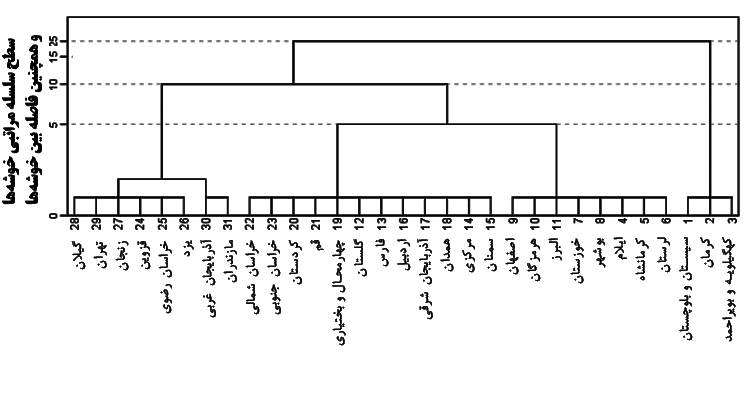
The dendrogram illustrates how provinces are connected based on similarities in employment Indices. Its horizontal axis represents the degree of distance or similarity between groups. In each step, two groups or variables with the greatest similarity merge to form a new cluster.
Discussion
The findings underscore the critical role of employment in fostering economic and social stability. A clear north-south divide is evident, with provinces in Cluster 1 demonstrating stronger economic participation and private sector dynamism compared to those in Cluster 4, which face profound economic challenges. Policy interventions should prioritize authentic private sector development, enhance industrial and service infrastructure, and strengthen vocational training and job placement programs in disadvantaged regions. Furthermore, leveraging the maritime potential of the southern provinces and strategically promoting the tourism sector can create significant employment opportunities. Ultimately, the cluster analysis provides a robust framework for designing tailored, region-specific policies to achieve sustainable and equitable development across the country.
Ethical considerations:
Hamid Masoudi was responsible for the study design, data collection, hierarchical cluster analysis, drafting the initial manuscript, and final revisions. Alireza Ghorbani contributed to data collection, review of statistical sources, and editing the final manuscript. This research received no financial support from any governmental or private institutions and was conducted independently by the authors. The authors declare no conflicts of interest related to this study. The research was conducted without any financial or non-financial affiliations with organizations or individuals.
Introduction
Unemployment and underemployment present significant global challenges to economic development, exacerbating social, political, and cultural problems. In Iran, an underutilized workforce continues to constrain national economic growth. This study investigates the determinants of employment across Iranian provinces by applying cluster analysis to identify regional disparities and categorize provinces based on key macroeconomic indicators related to employment and entrepreneurship. The ultimate aim is to provide policymakers with evidence-based insights to effectively reduce unemployment, enhance employment conditions, and foster entrepreneurship at the regional level.
Method
This descriptive-analytical study utilizes secondary data to classify Iranian provinces based on key macroeconomic employment indicators. Data were extracted from national statistical sources, including the Statistical Center of Iran’s 2025 Yearbook, the 2016 National Census, and the 2023 Yearbook of the Ministry of Cooperatives, Labor, and Social Welfare. Core indicators encompassed the economic participation rate, employment rate, and sectoral employment distribution. A hierarchical cluster analysis—a multivariate technique—was employed to group provinces according to structural similarities, minimizing within-group variance. The analysis was performed using specialized statistical software to ensure a robust classification of all provinces.
Findings
The analysis reveals significant regional disparities in employment profiles. Provinces such as Gilan, Kurdistan, Qazvin, and West Azerbaijan exhibit high economic participation and substantial private sector employment, indicating robust labor market engagement. Conversely, Sistan and Baluchestan and Kohgiluyeh and Boyer-Ahmad demonstrate lower economic participation and employment rates, with the former recording the lowest private sector employment (7.87%) and the latter the lowest job placement success (5.20%).
Driven by high population density, Tehran, Alborz, and Qom dominate service sector employment but show minimal engagement in agriculture. Notably, Gilan and West Azerbaijan, despite their strong overall participation, exhibit low industrial employment rates (7.21% and 4.23%, respectively).
Hierarchical cluster analysis categorized the provinces into four distinct groups:
Cluster 1: Gilan, Tehran, Zanjan, Qazvin, Khorasan Razavi, Yazd, West Azerbaijan, Mazandaran
Cluster 2: North Khorasan, South Khorasan, Kurdistan, Qom, Chaharmahal and Bakhtiari, Golestan, Fars, Ardabil, East Azerbaijan, Hamedan, Markazi, Semnan
Cluster 3: Isfahan, Hormozgan, Alborz, Khuzestan, Bushehr, Ilam, Kermanshah, Lorestan
Cluster 4: Sistan and Baluchestan, Kerman, Kohgiluyeh and Boyer-Ahmad
These clusters reflect varying degrees of economic vitality and sectoral specialization, a relationship visually summarized in a dendrogram that illustrates inter-provincial similarities.
The dendrogram illustrates how provinces are connected based on similarities in employment Indices. Its horizontal axis represents the degree of distance or similarity between groups. In each step, two groups or variables with the greatest similarity merge to form a new cluster.
Discussion
The findings underscore the critical role of employment in fostering economic and social stability. A clear north-south divide is evident, with provinces in Cluster 1 demonstrating stronger economic participation and private sector dynamism compared to those in Cluster 4, which face profound economic challenges. Policy interventions should prioritize authentic private sector development, enhance industrial and service infrastructure, and strengthen vocational training and job placement programs in disadvantaged regions. Furthermore, leveraging the maritime potential of the southern provinces and strategically promoting the tourism sector can create significant employment opportunities. Ultimately, the cluster analysis provides a robust framework for designing tailored, region-specific policies to achieve sustainable and equitable development across the country.
Ethical considerations:
Hamid Masoudi was responsible for the study design, data collection, hierarchical cluster analysis, drafting the initial manuscript, and final revisions. Alireza Ghorbani contributed to data collection, review of statistical sources, and editing the final manuscript. This research received no financial support from any governmental or private institutions and was conducted independently by the authors. The authors declare no conflicts of interest related to this study. The research was conducted without any financial or non-financial affiliations with organizations or individuals.
Type of Study: orginal |
Received: 2025/01/3 | Accepted: 2025/09/2 | Published: 2025/10/4
Received: 2025/01/3 | Accepted: 2025/09/2 | Published: 2025/10/4
Send email to the article author
| Rights and permissions | |
 |
This work is licensed under a Creative Commons Attribution-NonCommercial 4.0 International License. |

Contact Information
Copyright © The Author(s);
This is an open access article distributed under the terms of the Creative Commons Attribution-NonCommercial 4.0 (CC-By-NC 4.0), which permits use, distribution, and reproduction in any medium, provided the original work is properly cited and is not used for commercial purposes.
Contact Information
