
Volume 25, Issue 98 (10-2025)
Social Welfare Quarterly 2025, 25(98): 223-250 |
Back to browse issues page



Ethics code: IR.MUI.NUREMA.REC.1402.017


Download citation:
BibTeX | RIS | EndNote | Medlars | ProCite | Reference Manager | RefWorks
Send citation to:


BibTeX | RIS | EndNote | Medlars | ProCite | Reference Manager | RefWorks
Send citation to:
Nejad labbaf S, Mousavi A, Amini-Rarani M. (2025). The Role of Social Capital in Promoting Environmentally Friendly Behaviors among Students at Isfahan University of Medical Sciences. Social Welfare Quarterly. 25(98), 223-250. doi:10.32598/refahj.25.98.4109.1
URL: http://refahj.uswr.ac.ir/article-1-4421-en.html
URL: http://refahj.uswr.ac.ir/article-1-4421-en.html

Keywords: Pro-environmental behaviors, Medical students, Social capital, Individual trust, Social cohesion-support
Full-Text [PDF 527 kb]
(587 Downloads)
| Abstract (HTML) (3353 Views)
Full-Text: (619 Views)
Introduction
Global warming and climate change are among the most pressing environmental challenges facing humanity today, drawing significant attention from scientists and policymakers worldwide (ZareShahabadi et al, 2016). A brief examination of environmental conditions over recent decades reveals that misguided human thoughts, attitudes, and actions are the primary contributors to this global crisis. Human interventions in the environment not only lead to detrimental effects on human health but also influence economic, social, and cultural development (SiarKhalaj et al, 2014). Consequently, human behavior is a growing focus as a key factor in safeguarding environmental interests and enhancing environmental quality (Aghili et al, 2009). This highlights the need for new strategies aimed at environmental protection, one of which is the promotion of pro-environmental behaviors. Environmental behavior encompasses intentional or unintentional actions that significantly impact the environment.
Historically, universities have played a crucial role in transforming societies by educating decision-makers, leaders, entrepreneurs, and academics. However, sustainability education and research in many institutions are still in their early stages. Key questions arise: Are universities at the forefront of developing and communicating sustainable development models to their students? Are they responding effectively to societal pressures? What steps can university leaders and faculty take to ensure that sustainable development becomes an integral part of university culture? Have efforts been made to address students’ attitudes and perceptions regarding environmental sustainability? (Lozano et ai., 2013).
Given the specialized training and heightened responsibility of medical university students in combating diseases linked to environmental factors, their environmental behaviors are particularly significant. Medical students’ awareness and attitudes can greatly influence society’s present and future, enabling them to become cultural leaders and future decision-makers aligned with environmental protection. However, few studies in Iran have explored this critical issue within the country’s medical universities. Additionally, since individuals in each society exhibit varying attitudes toward the environment based on their specific social, cultural, and personal contexts, this study aims to investigate the relationship between social capital and environmental behaviors among students at Isfahan University of Medical Sciences. It will examine three dimensions: “individual trust,” “solidarity and social support,” and “social trust and community relations.” The study seeks to describe the current situation and analyze the relationship between “social capital” and “environmental behaviors,” while also providing recommendations for enhancing pro-environmental behaviors among students.
Methods
This descriptive-analytical study employed a cross-sectional design during the first semester of 2024. A random sample of 600 students from Isfahan University of Medical Sciences was selected, representing four academic levels: bachelor’s, master’s, professional doctorate (Doctor of Medicine), and PhD. Data were collected using two primary instruments: the Urban HEART-1 Social Capital Questionnaire, measuring three components (Personal Trust, Social Support and Solidarity, and Social Trust and Community Relations), and a validated Pro-Environmental Behaviors Questionnaire assessing six domains—gas, electricity, and water conservation; use of eco-friendly products; protection of natural resources; and use of recycled items. Data analysis was conducted in SPSS 26 using Spearman’s correlation coefficient and the Kruskal-Wallis test.
Findings
The analytical findings indicated an overall weak level of social capital among the students (Mean = 156.96, SD = 24.49). Among its dimensions, “Personal Trust” (Mean = 68.70, SD = 13.44) was also rated as weak, while “Social Trust and Community Relations” (Mean = 47.31, SD = 9.41) was assessed as very weak, and “Solidarity and Social Support” (Mean = 40.94, SD = 7.20) as weak.
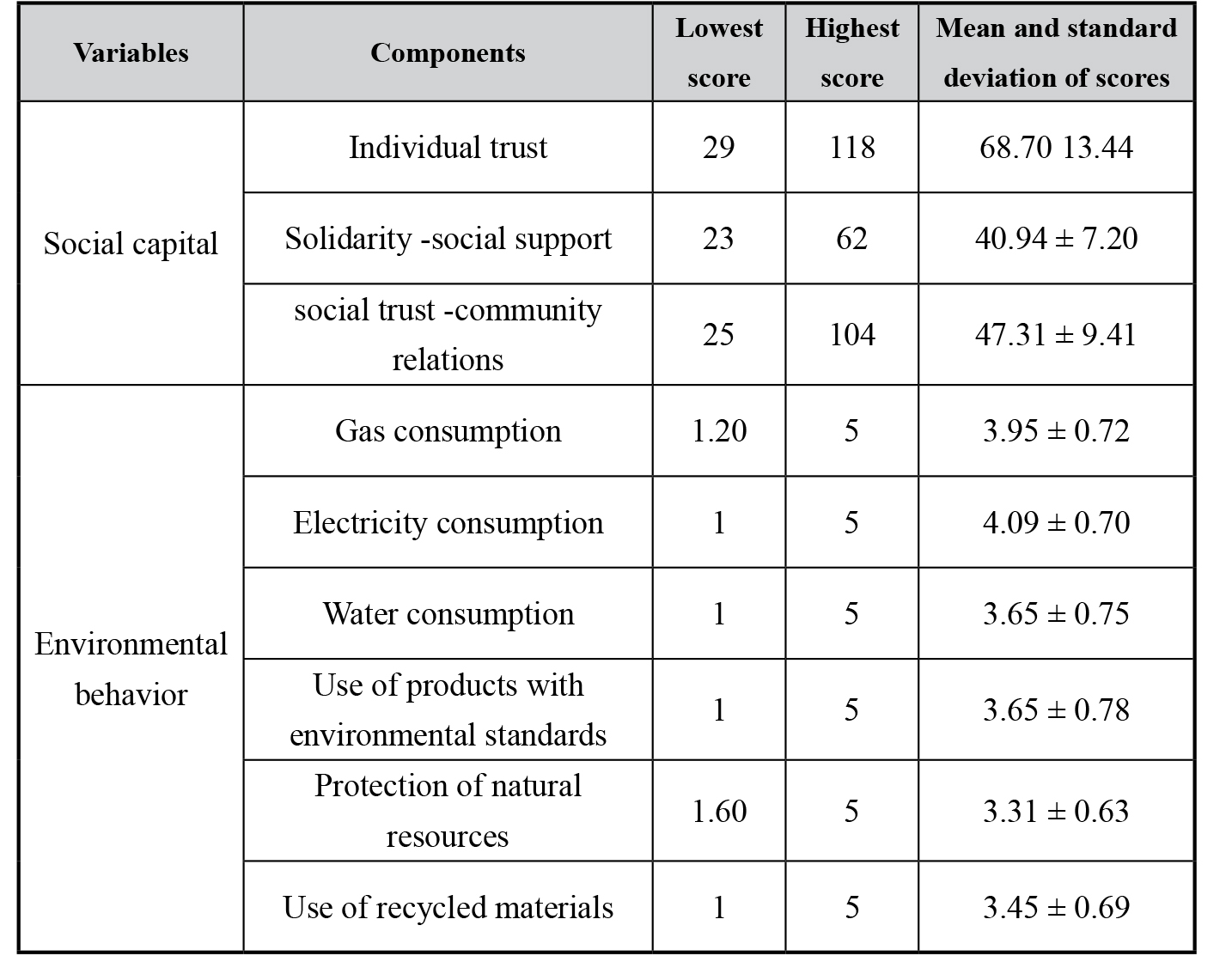
Regarding pro-environmental behaviors, the students demonstrated a moderate overall level (Mean = 102.92, SD = 13.77). An analysis of the specific behavioral domains revealed moderate levels in gas consumption, water consumption, use of eco-friendly products, protection of natural resources, and recycling practices. In contrast, electricity consumption was the only domain classified as strong. The descriptive statistics for all study variables are presented in Table 1.
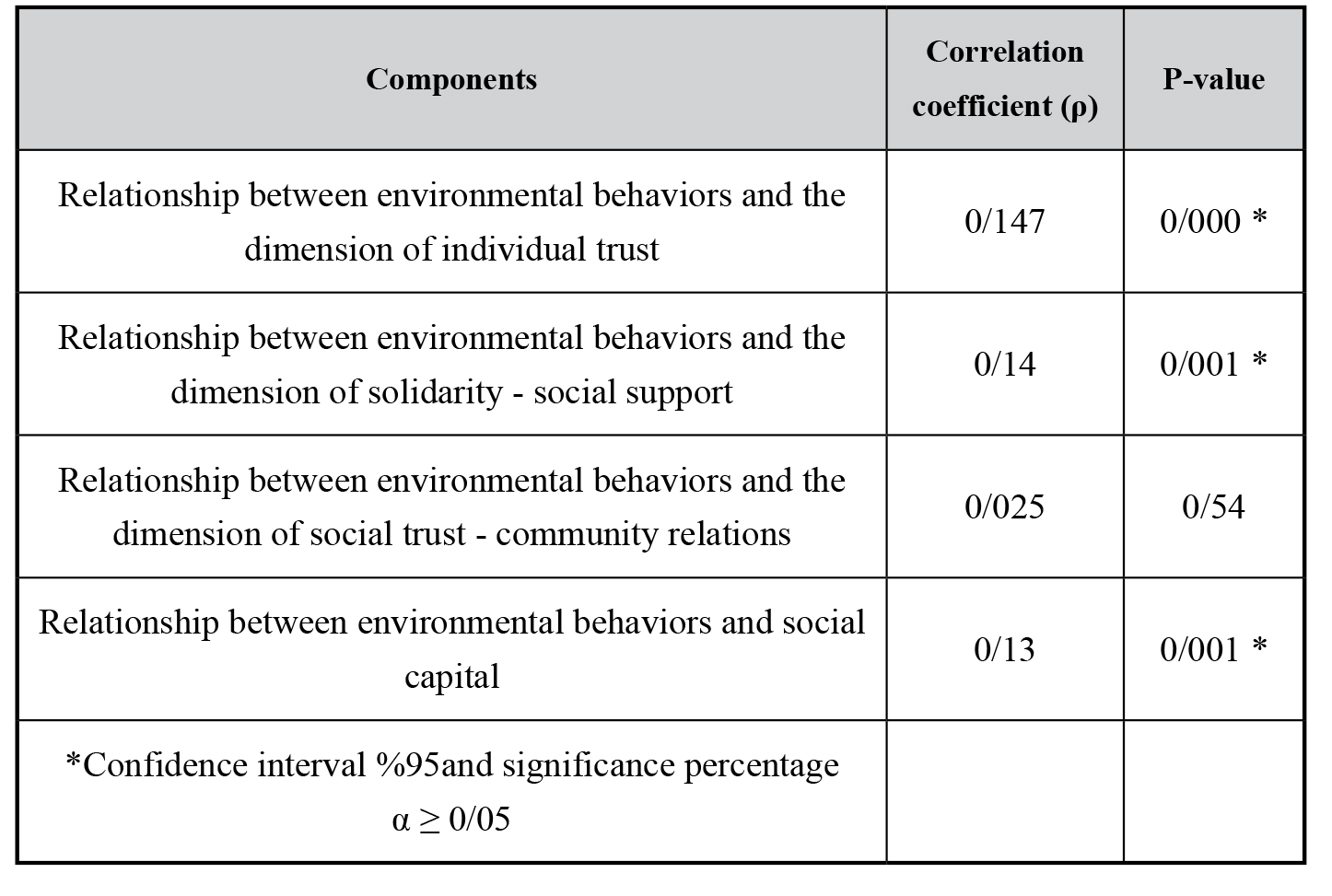
As shown in Table 2, a positive and significant correlation was observed between environmental behavior and the “personal trust” and “social solidarity-support” dimensions of social capital. In contrast, no significant relationship was found between the “social trust-associational relations” dimension and environmental behavior. Furthermore, the analysis revealed a positive and significant association between the overall social capital variable and environmental behavior.
Identifying and explaining students’ attitudes toward the environment as factors affecting society is an important step in shaping policy and raising a generation aware of environmental issues and how to address related risks. The results of measuring the environmental behavior of students at Isfahan University of Medical Sciences indicated that their pro-environmental behaviors were not satisfactory. This situation stemmed from a lack of adherence to sustainable consumption patterns in various aspects of environmental behavior, including energy consumption, the use of environmentally friendly products, the protection of natural resources, and the use of recycled materials.
As noted in the findings, the social capital among students at Isfahan University of Medical Sciences was weak. This weakness can be attributed to several factors, including a low level of collective and voluntary activities, limited solidarity and social networks, weak interpersonal bonds and interactions, decreased individual and social trust, reduced social support, a lack of adherence to shared values, and a diminished sense of belonging and solidarity.
Our analysis of the relationship between social capital and environmental behavior revealed a positive and significant correlation between these two variables. Therefore, we anticipate that improving the social capital index will also enhance environmental behavior. Additionally, it appears that increasing the components of “individual trust” and “ solidarity/ social support” will further promote positive environmental behavior.
To foster improvements in environmental behavior among students, it is essential to boost collective and voluntary activities, enhance trust, increase social support, cultivate solidarity, strengthen the sense of belonging, and develop robust social networks.
The current study emphasizes the importance of examining and considering the potential impact of social factors when planning environmental initiatives. It can serve as a foundation for applying social capital theory to enhance the academic community’s efforts in improving environmental behaviors at universities.
Policymakers and higher education planners should focus on strengthening students’ social capital by expanding their social networks and associations. This includes the formation and development of student and sports organizations, as well as increasing opportunities for gatherings. Identifying educational needs and developing appropriate curricula to promote social capital and environmentally friendly lifestyles at various educational levels are essential pillars in this effort. Additionally, it is recommended to conduct workshops and training courses, organize periodic conferences, and prepare and distribute pamphlets and educational materials among students. Therefore, developing a comprehensive program to promote environmental culture among students at the country’s universities of medical sciences will be beneficial. This program should aim to familiarize students with new concepts of sustainable development and environmental protection.
Ethical Considerations
Authors’ Contributions
All authors contributed to the preparation of this article with full awareness and consent.
Funding
No financial support has been received from any institution or organization for the preparation of this article.
Conflict of Interest
The authors declare that there are no conflicts of interest related to the writing of this article.
Adherence to Ethical Principles
Information related to participants was kept confidential, and the questionnaires were anonymous, containing no personal identifiers. Participants in the study had complete freedom to complete the questionnaires. This research has been approved by the Research Vice Presidency of Isfahan University of Medical Sciences under the ethics code IR.MUI.NUREMA.REC.1402.017.
Aghili, S. M., Khoshfar, G. R., & Salehi, S. (2009). Social Capital and Responsible Environmental Behaviors in Northern Iran (Case Study: Gilan, Mazandaran and Golestan Provinces). Journal of AgriculturalSciencesandNaturalResources,16(1),236-250. [In Persian]. https://www.sid.ir/paper/443294/fa
Lozano, R., Lozano, F. J., Mulder, K., Huisingh, D., & Waas, T. (2013). Advancing higher education for sustainable development: international insights and critical reflections. Journal of Cleaner Production, 48, 3-9. https://doi.org/10.1016/j.jclepro.2013.03.034
Siarkhalaj, H., Shokoohifar, K., & Farahmand, M. (2014). Investigating social factors affecting environmental behaviors (case study: citizens of Yazd city). Journal of Urban Sociological Studies, 4(10), 141-109. [In Persian]. https://www.sid.ir/paper/210392/fa
Zareshahabadi, A., Sayarkhalaj, H., & Aghaabdollahmahootfooroosh, S. (2016). Factors Associated with Environmental Behavior in the Urban Environment (Case Study: the Citizens of the City of Karaj). Journal of environmental education and sustainable development, 5(1), 27-39 [In Persian]. https://www.sid.ir/paper/261011/en
Global warming and climate change are among the most pressing environmental challenges facing humanity today, drawing significant attention from scientists and policymakers worldwide (ZareShahabadi et al, 2016). A brief examination of environmental conditions over recent decades reveals that misguided human thoughts, attitudes, and actions are the primary contributors to this global crisis. Human interventions in the environment not only lead to detrimental effects on human health but also influence economic, social, and cultural development (SiarKhalaj et al, 2014). Consequently, human behavior is a growing focus as a key factor in safeguarding environmental interests and enhancing environmental quality (Aghili et al, 2009). This highlights the need for new strategies aimed at environmental protection, one of which is the promotion of pro-environmental behaviors. Environmental behavior encompasses intentional or unintentional actions that significantly impact the environment.
Historically, universities have played a crucial role in transforming societies by educating decision-makers, leaders, entrepreneurs, and academics. However, sustainability education and research in many institutions are still in their early stages. Key questions arise: Are universities at the forefront of developing and communicating sustainable development models to their students? Are they responding effectively to societal pressures? What steps can university leaders and faculty take to ensure that sustainable development becomes an integral part of university culture? Have efforts been made to address students’ attitudes and perceptions regarding environmental sustainability? (Lozano et ai., 2013).
Given the specialized training and heightened responsibility of medical university students in combating diseases linked to environmental factors, their environmental behaviors are particularly significant. Medical students’ awareness and attitudes can greatly influence society’s present and future, enabling them to become cultural leaders and future decision-makers aligned with environmental protection. However, few studies in Iran have explored this critical issue within the country’s medical universities. Additionally, since individuals in each society exhibit varying attitudes toward the environment based on their specific social, cultural, and personal contexts, this study aims to investigate the relationship between social capital and environmental behaviors among students at Isfahan University of Medical Sciences. It will examine three dimensions: “individual trust,” “solidarity and social support,” and “social trust and community relations.” The study seeks to describe the current situation and analyze the relationship between “social capital” and “environmental behaviors,” while also providing recommendations for enhancing pro-environmental behaviors among students.
Methods
This descriptive-analytical study employed a cross-sectional design during the first semester of 2024. A random sample of 600 students from Isfahan University of Medical Sciences was selected, representing four academic levels: bachelor’s, master’s, professional doctorate (Doctor of Medicine), and PhD. Data were collected using two primary instruments: the Urban HEART-1 Social Capital Questionnaire, measuring three components (Personal Trust, Social Support and Solidarity, and Social Trust and Community Relations), and a validated Pro-Environmental Behaviors Questionnaire assessing six domains—gas, electricity, and water conservation; use of eco-friendly products; protection of natural resources; and use of recycled items. Data analysis was conducted in SPSS 26 using Spearman’s correlation coefficient and the Kruskal-Wallis test.
Findings
The analytical findings indicated an overall weak level of social capital among the students (Mean = 156.96, SD = 24.49). Among its dimensions, “Personal Trust” (Mean = 68.70, SD = 13.44) was also rated as weak, while “Social Trust and Community Relations” (Mean = 47.31, SD = 9.41) was assessed as very weak, and “Solidarity and Social Support” (Mean = 40.94, SD = 7.20) as weak.
Regarding pro-environmental behaviors, the students demonstrated a moderate overall level (Mean = 102.92, SD = 13.77). An analysis of the specific behavioral domains revealed moderate levels in gas consumption, water consumption, use of eco-friendly products, protection of natural resources, and recycling practices. In contrast, electricity consumption was the only domain classified as strong. The descriptive statistics for all study variables are presented in Table 1.
Table 1: Average scores of social capital and environmental behavior variables among students at Isfahan University of Medical Sciences.
As shown in Table 2, a positive and significant correlation was observed between environmental behavior and the “personal trust” and “social solidarity-support” dimensions of social capital. In contrast, no significant relationship was found between the “social trust-associational relations” dimension and environmental behavior. Furthermore, the analysis revealed a positive and significant association between the overall social capital variable and environmental behavior.
Table 2: The relationship` between social capital and environmental behavior among Isfahan medical students.
DisscusionIdentifying and explaining students’ attitudes toward the environment as factors affecting society is an important step in shaping policy and raising a generation aware of environmental issues and how to address related risks. The results of measuring the environmental behavior of students at Isfahan University of Medical Sciences indicated that their pro-environmental behaviors were not satisfactory. This situation stemmed from a lack of adherence to sustainable consumption patterns in various aspects of environmental behavior, including energy consumption, the use of environmentally friendly products, the protection of natural resources, and the use of recycled materials.
As noted in the findings, the social capital among students at Isfahan University of Medical Sciences was weak. This weakness can be attributed to several factors, including a low level of collective and voluntary activities, limited solidarity and social networks, weak interpersonal bonds and interactions, decreased individual and social trust, reduced social support, a lack of adherence to shared values, and a diminished sense of belonging and solidarity.
Our analysis of the relationship between social capital and environmental behavior revealed a positive and significant correlation between these two variables. Therefore, we anticipate that improving the social capital index will also enhance environmental behavior. Additionally, it appears that increasing the components of “individual trust” and “ solidarity/ social support” will further promote positive environmental behavior.
To foster improvements in environmental behavior among students, it is essential to boost collective and voluntary activities, enhance trust, increase social support, cultivate solidarity, strengthen the sense of belonging, and develop robust social networks.
The current study emphasizes the importance of examining and considering the potential impact of social factors when planning environmental initiatives. It can serve as a foundation for applying social capital theory to enhance the academic community’s efforts in improving environmental behaviors at universities.
Policymakers and higher education planners should focus on strengthening students’ social capital by expanding their social networks and associations. This includes the formation and development of student and sports organizations, as well as increasing opportunities for gatherings. Identifying educational needs and developing appropriate curricula to promote social capital and environmentally friendly lifestyles at various educational levels are essential pillars in this effort. Additionally, it is recommended to conduct workshops and training courses, organize periodic conferences, and prepare and distribute pamphlets and educational materials among students. Therefore, developing a comprehensive program to promote environmental culture among students at the country’s universities of medical sciences will be beneficial. This program should aim to familiarize students with new concepts of sustainable development and environmental protection.
Ethical Considerations
Authors’ Contributions
All authors contributed to the preparation of this article with full awareness and consent.
Funding
No financial support has been received from any institution or organization for the preparation of this article.
Conflict of Interest
The authors declare that there are no conflicts of interest related to the writing of this article.
Adherence to Ethical Principles
Information related to participants was kept confidential, and the questionnaires were anonymous, containing no personal identifiers. Participants in the study had complete freedom to complete the questionnaires. This research has been approved by the Research Vice Presidency of Isfahan University of Medical Sciences under the ethics code IR.MUI.NUREMA.REC.1402.017.
Aghili, S. M., Khoshfar, G. R., & Salehi, S. (2009). Social Capital and Responsible Environmental Behaviors in Northern Iran (Case Study: Gilan, Mazandaran and Golestan Provinces). Journal of AgriculturalSciencesandNaturalResources,16(1),236-250. [In Persian]. https://www.sid.ir/paper/443294/fa
Lozano, R., Lozano, F. J., Mulder, K., Huisingh, D., & Waas, T. (2013). Advancing higher education for sustainable development: international insights and critical reflections. Journal of Cleaner Production, 48, 3-9. https://doi.org/10.1016/j.jclepro.2013.03.034
Siarkhalaj, H., Shokoohifar, K., & Farahmand, M. (2014). Investigating social factors affecting environmental behaviors (case study: citizens of Yazd city). Journal of Urban Sociological Studies, 4(10), 141-109. [In Persian]. https://www.sid.ir/paper/210392/fa
Zareshahabadi, A., Sayarkhalaj, H., & Aghaabdollahmahootfooroosh, S. (2016). Factors Associated with Environmental Behavior in the Urban Environment (Case Study: the Citizens of the City of Karaj). Journal of environmental education and sustainable development, 5(1), 27-39 [In Persian]. https://www.sid.ir/paper/261011/en
Type of Study: orginal |
Received: 2025/01/1 | Accepted: 2025/09/14 | Published: 2025/10/4
Received: 2025/01/1 | Accepted: 2025/09/14 | Published: 2025/10/4
Send email to the article author
| Rights and permissions | |
 |
This work is licensed under a Creative Commons Attribution-NonCommercial 4.0 International License. |

Contact Information
Copyright © The Author(s);
This is an open access article distributed under the terms of the Creative Commons Attribution-NonCommercial 4.0 (CC-By-NC 4.0), which permits use, distribution, and reproduction in any medium, provided the original work is properly cited and is not used for commercial purposes.
Contact Information
