

Volume 26, Issue 1 (4-2026)
Social Welfare Quarterly 2026, 26(1): 187-220 |
Back to browse issues page



Download citation:
BibTeX | RIS | EndNote | Medlars | ProCite | Reference Manager | RefWorks
Send citation to:


BibTeX | RIS | EndNote | Medlars | ProCite | Reference Manager | RefWorks
Send citation to:
Nazari F, Norouzi M, Mohamadi Ghareh Ghani M A. (2026). A Scoping Review of Iranian Studies on Football Hooliganism: Theoretical Trends, Methodological Patterns, and Key Determinants. Social Welfare Quarterly. 26(1), 187-220. doi:10.32598/refahj.26.100.1
URL: http://refahj.uswr.ac.ir/article-1-4462-en.html
URL: http://refahj.uswr.ac.ir/article-1-4462-en.html

Keywords: Football hooliganism, scoping review, spectator behavior, frustration–aggression theory, Iran.
Full-Text [PDF 783 kb]
(317 Downloads)
| Abstract (HTML) (1756 Views)
Full-Text: (24 Views)
Extended Abstract
Introduction
Football hooliganism, characterized by collective and often violent behavior among football fans, has become a persistent issue in contemporary sports culture. Scholars such as Dunning (2000) view hooliganism as a form of symbolic violence rooted in identity conflicts, frustration, and social alienation. In Iran, it has appeared in forms such as fan clashes, property damage, and aggressive collective behavior surrounding football events. Despite its social and economic consequences, scholarly understanding of hooliganism remains fragmented and largely descriptive. Most studies have focused on psychological or managerial explanations, while broader socio-cultural and institutional dimensions have received limited attention. Beyond threatening public safety, hooliganism undermines social welfare by disrupting urban peace, emotional security, and public trust.
This study conducts a scoping review of Iranian research on football hooliganism to map existing studies, evaluate methodological trends, and identify conceptual patterns across the literature. The review follows the PRISMA 2020 reporting framework adapted for scoping reviews.
The key research questions guiding the review are:
What are the main variables and factors influencing football hooliganism in Iran?
Which theoretical frameworks (social, psychological, cultural, institutional) are most applied?
What methodological trends dominate the Iranian literature, and where are the research gaps?
Method
The study employs the PRISMA 2020 guideline for systematic reviews. A structured search was conducted in five Persian academic databases—SID, MagIran, ISC, Noormags, and Ensani—covering the years 2000–2024. Boolean operators and Persian equivalents of “football hooliganism,” “spectator violence,” and “vandalism in sports” were used to maximize coverage.
Screening and Inclusion Criteria
The inclusion criteria required that studies:
Be published in peer-reviewed Persian journals or as postgraduate theses,
Address hooliganism, spectator behavior, or violence in football,
Include empirical data (quantitative, qualitative, or mixed methods).
Studies were excluded if they focused solely on other sports, lacked methodological clarity, or were purely theoretical. Out of 54 initially identified studies, 50 met the inclusion criteria after duplicate removal and quality appraisal.
Quality Assessment
Each study was evaluated using the Mixed Methods Appraisal Tool (MMAT, 2018) translated as the Instrument for Assessing the Quality of Mixed-Method Research. The assessment considered sampling, data collection, analysis transparency, and triangulation.
A summary of the quality evaluation is shown in Table 2 (see main article):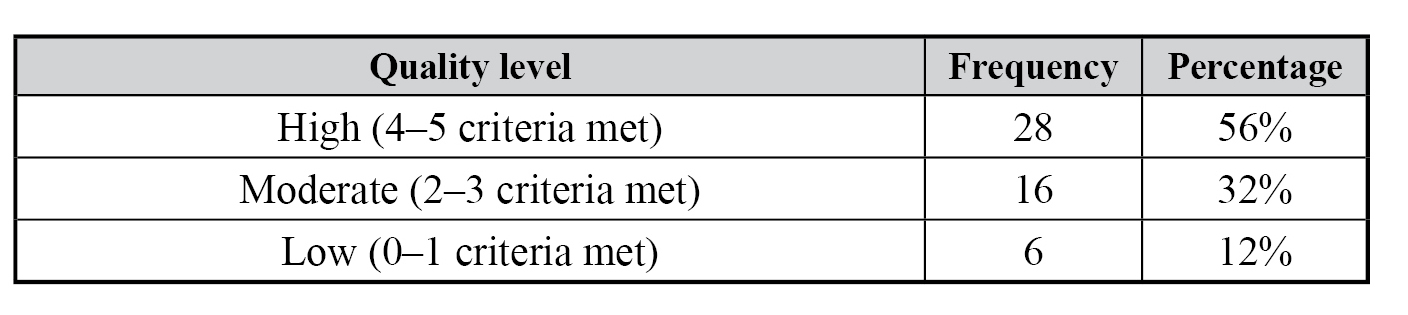 Data Analysis
Data extraction was performed independently by two coders, achieving a Scott’s π = 0.89, indicating high inter-coder reliability. Using Excel, all variables (independent, dependent, mediating), theoretical approaches, and research methods were coded and clustered.
Thematic and comparative analyses were employed to identify recurring conceptual patterns and reported relational trends across studies.
A conceptual mapping framework was constructed (Figure 1 in main text) to illustrate how frustration, social pressures, and institutional weaknesses interact to produce hooligan behavior.
Findings
1. General Characteristics of Reviewed Studies
Timeframe: Most studies were published between 2010–2020, with peaks during 2016–2020.
Discipline: 40% belonged to sociology, 24% to psychology, 16% to sports management, and 12% to criminology.
Geographical focus: 50% of studies were conducted in Tehran, showing an urban bias.
Methodology: 70% positivist, 20% interpretivist, and 10% critical paradigms (Table 3).
Design: 64% quantitative, 20% qualitative, 16% mixed (Table 4).
Sample: 70% of participants were football spectators (Table 5).
2. Theoretical Frameworks
The most frequently used frameworks were:
Frustration–Aggression Theory (16%), emphasizing emotional arousal and unfulfilled social expectations.
Sociological Theories (20%), focusing on group identity, social class, and cultural factors.
Criminological and Media Theories (12% each), exploring deviance and mediated violence. About 16% of studies lacked a clear theoretical foundation, showing a theoretical gap in the field.
3. Variables and Causal Patterns
From the extracted data, three commonly reported levels of explanation were observed: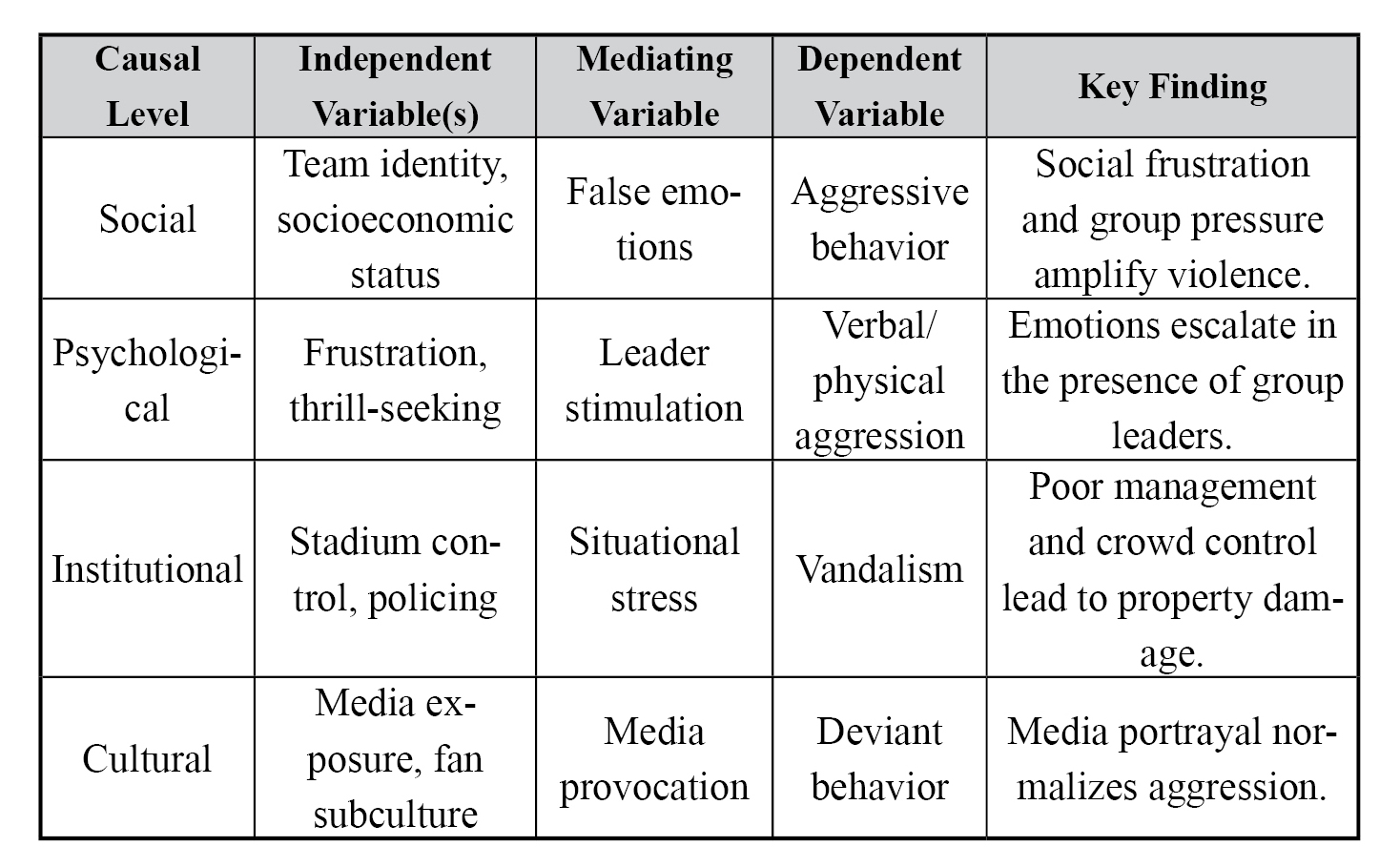
The above relationships are illustrated in the Integrative Model of Hooliganism in Iran (Figure 4).
4. Thematic Synthesis
Five dominant thematic clusters emerged:
Aggressive Behaviors (40%) – verbal and physical violence, emotional arousal.
Social and Cultural Factors (24%) – social class, identity, fan culture.
Role of Media (16%) – provocation, biased broadcasting.
Management and Policing (12%) – institutional control, stadium security.
Psychological and Economic Factors (18%) – frustration, inequality, economic pressure.
Methodological Trends
The dominance of quantitative methods has produced a primarily descriptive account of hooliganism, while the scarcity of qualitative and ethnographic studies has limited understanding of its cultural and experiential dimensions.
Discussion
The review indicates that Iranian research on football hooliganism is dominated by behavioral and managerial perspectives, with limited engagement with structural and cultural dimensions. While quantitative findings identify direct relationships between frustration, crowd density, and aggression, few studies examine how social institutions—such as media, education, and policing—reproduce these behaviors.
Conceptual Implications
The review highlights dual explanatory logic:
Micro-level (psychological): frustration, emotional arousal, and leader influence.
Meso-level (social): group identity, class, and cultural values.
Macro-level (institutional): weak governance, inadequate policing, and media sensationalism.
These findings align with Smith (2016) and Wann & Grieve (2017), who note that hooliganism arises where structural frustrations meet expressive cultural rituals.
Policy and Research Recommendations
Develop interdisciplinary models integrating sociological, psychological, and media perspectives.
Promote qualitative inquiry—ethnography and narrative interviews—to uncover lived meanings of aggression.
Design preventive interventions targeting fan education, stadium safety, and media ethics.
Incorporate policy evaluation mechanisms within sports governance to assess the effectiveness of anti-violence strategies.
Football hooliganism in Iran is not merely a product of individual aggression, but a complex socio-cultural phenomenon embedded in identity politics, urban tensions, and institutional failures. The review underscores the need for context-sensitive, evidence-based policies that go beyond disciplinary boundaries.
Ethical Considerations
Compliance With Ethical Guidelines
In this study, more than 50 scientific articles and relevant sources were reviewed and analyzed. All stages of data collection, analysis, and reporting were conducted in accordance with research ethics principles, and all sources used have been appropriately cited in the reference list.
Authors’ Contributions
Milad Norouzi was responsible for the study design, data collection and analysis, and preparation of the initial manuscript draft. Fahimeh Nazari contributed to data collection, scientific revision, and preparation of the final version of the manuscript. Mohammad Ali Mohammadi Gharehghani was responsible for the final scientific review and evaluation of the manuscript.
Funding
This research received no financial support from any governmental, private, or non-profit organizations and was conducted independently by the authors.
Conflict of Interest
The authors declare that there are no conflicts of interest regarding the publication of this study.
Dunning, E. (2000). Sport matters: Sociological studies of sport, violence and civilization. Routledge. https://books.google.com/books/about/Sport_Matters.html?id=tq23noiMKFcC&utm_source=chatgpt.com
Smith, R. (2016). The sociology of football fandom: Identity, community and culture. Routledge.
Wann, D. L., & Grieve, F. G. (2017). Affective outcomes of sport team identification: The positive and negative consequences of sports fandom. Journal of Sport Behavior, 40(4), 432–450.
Introduction
Football hooliganism, characterized by collective and often violent behavior among football fans, has become a persistent issue in contemporary sports culture. Scholars such as Dunning (2000) view hooliganism as a form of symbolic violence rooted in identity conflicts, frustration, and social alienation. In Iran, it has appeared in forms such as fan clashes, property damage, and aggressive collective behavior surrounding football events. Despite its social and economic consequences, scholarly understanding of hooliganism remains fragmented and largely descriptive. Most studies have focused on psychological or managerial explanations, while broader socio-cultural and institutional dimensions have received limited attention. Beyond threatening public safety, hooliganism undermines social welfare by disrupting urban peace, emotional security, and public trust.
This study conducts a scoping review of Iranian research on football hooliganism to map existing studies, evaluate methodological trends, and identify conceptual patterns across the literature. The review follows the PRISMA 2020 reporting framework adapted for scoping reviews.
The key research questions guiding the review are:
What are the main variables and factors influencing football hooliganism in Iran?
Which theoretical frameworks (social, psychological, cultural, institutional) are most applied?
What methodological trends dominate the Iranian literature, and where are the research gaps?
Method
The study employs the PRISMA 2020 guideline for systematic reviews. A structured search was conducted in five Persian academic databases—SID, MagIran, ISC, Noormags, and Ensani—covering the years 2000–2024. Boolean operators and Persian equivalents of “football hooliganism,” “spectator violence,” and “vandalism in sports” were used to maximize coverage.
Screening and Inclusion Criteria
The inclusion criteria required that studies:
Be published in peer-reviewed Persian journals or as postgraduate theses,
Address hooliganism, spectator behavior, or violence in football,
Include empirical data (quantitative, qualitative, or mixed methods).
Studies were excluded if they focused solely on other sports, lacked methodological clarity, or were purely theoretical. Out of 54 initially identified studies, 50 met the inclusion criteria after duplicate removal and quality appraisal.
Quality Assessment
Each study was evaluated using the Mixed Methods Appraisal Tool (MMAT, 2018) translated as the Instrument for Assessing the Quality of Mixed-Method Research. The assessment considered sampling, data collection, analysis transparency, and triangulation.
A summary of the quality evaluation is shown in Table 2 (see main article):
Data extraction was performed independently by two coders, achieving a Scott’s π = 0.89, indicating high inter-coder reliability. Using Excel, all variables (independent, dependent, mediating), theoretical approaches, and research methods were coded and clustered.
Thematic and comparative analyses were employed to identify recurring conceptual patterns and reported relational trends across studies.
A conceptual mapping framework was constructed (Figure 1 in main text) to illustrate how frustration, social pressures, and institutional weaknesses interact to produce hooligan behavior.
Findings
1. General Characteristics of Reviewed Studies
Timeframe: Most studies were published between 2010–2020, with peaks during 2016–2020.
Discipline: 40% belonged to sociology, 24% to psychology, 16% to sports management, and 12% to criminology.
Geographical focus: 50% of studies were conducted in Tehran, showing an urban bias.
Methodology: 70% positivist, 20% interpretivist, and 10% critical paradigms (Table 3).
Design: 64% quantitative, 20% qualitative, 16% mixed (Table 4).
Sample: 70% of participants were football spectators (Table 5).
2. Theoretical Frameworks
The most frequently used frameworks were:
Frustration–Aggression Theory (16%), emphasizing emotional arousal and unfulfilled social expectations.
Sociological Theories (20%), focusing on group identity, social class, and cultural factors.
Criminological and Media Theories (12% each), exploring deviance and mediated violence. About 16% of studies lacked a clear theoretical foundation, showing a theoretical gap in the field.
3. Variables and Causal Patterns
From the extracted data, three commonly reported levels of explanation were observed:
The above relationships are illustrated in the Integrative Model of Hooliganism in Iran (Figure 4).
4. Thematic Synthesis
Five dominant thematic clusters emerged:
Aggressive Behaviors (40%) – verbal and physical violence, emotional arousal.
Social and Cultural Factors (24%) – social class, identity, fan culture.
Role of Media (16%) – provocation, biased broadcasting.
Management and Policing (12%) – institutional control, stadium security.
Psychological and Economic Factors (18%) – frustration, inequality, economic pressure.
Methodological Trends
The dominance of quantitative methods has produced a primarily descriptive account of hooliganism, while the scarcity of qualitative and ethnographic studies has limited understanding of its cultural and experiential dimensions.
Discussion
The review indicates that Iranian research on football hooliganism is dominated by behavioral and managerial perspectives, with limited engagement with structural and cultural dimensions. While quantitative findings identify direct relationships between frustration, crowd density, and aggression, few studies examine how social institutions—such as media, education, and policing—reproduce these behaviors.
Conceptual Implications
The review highlights dual explanatory logic:
Micro-level (psychological): frustration, emotional arousal, and leader influence.
Meso-level (social): group identity, class, and cultural values.
Macro-level (institutional): weak governance, inadequate policing, and media sensationalism.
These findings align with Smith (2016) and Wann & Grieve (2017), who note that hooliganism arises where structural frustrations meet expressive cultural rituals.
Policy and Research Recommendations
Develop interdisciplinary models integrating sociological, psychological, and media perspectives.
Promote qualitative inquiry—ethnography and narrative interviews—to uncover lived meanings of aggression.
Design preventive interventions targeting fan education, stadium safety, and media ethics.
Incorporate policy evaluation mechanisms within sports governance to assess the effectiveness of anti-violence strategies.
Football hooliganism in Iran is not merely a product of individual aggression, but a complex socio-cultural phenomenon embedded in identity politics, urban tensions, and institutional failures. The review underscores the need for context-sensitive, evidence-based policies that go beyond disciplinary boundaries.
Ethical Considerations
Compliance With Ethical Guidelines
In this study, more than 50 scientific articles and relevant sources were reviewed and analyzed. All stages of data collection, analysis, and reporting were conducted in accordance with research ethics principles, and all sources used have been appropriately cited in the reference list.
Authors’ Contributions
Milad Norouzi was responsible for the study design, data collection and analysis, and preparation of the initial manuscript draft. Fahimeh Nazari contributed to data collection, scientific revision, and preparation of the final version of the manuscript. Mohammad Ali Mohammadi Gharehghani was responsible for the final scientific review and evaluation of the manuscript.
Funding
This research received no financial support from any governmental, private, or non-profit organizations and was conducted independently by the authors.
Conflict of Interest
The authors declare that there are no conflicts of interest regarding the publication of this study.
Dunning, E. (2000). Sport matters: Sociological studies of sport, violence and civilization. Routledge. https://books.google.com/books/about/Sport_Matters.html?id=tq23noiMKFcC&utm_source=chatgpt.com
Smith, R. (2016). The sociology of football fandom: Identity, community and culture. Routledge.
Wann, D. L., & Grieve, F. G. (2017). Affective outcomes of sport team identification: The positive and negative consequences of sports fandom. Journal of Sport Behavior, 40(4), 432–450.
Type of Study: review |
Received: 2025/04/25 | Accepted: 2026/05/5 | Published: 2026/05/31
Received: 2025/04/25 | Accepted: 2026/05/5 | Published: 2026/05/31
Send email to the article author
| Rights and permissions | |
 |
This work is licensed under a Creative Commons Attribution-NonCommercial 4.0 International License. |

Contact Information
Copyright © The Author(s);
This is an open access article distributed under the terms of the Creative Commons Attribution-NonCommercial 4.0 (CC-By-NC 4.0), which permits use, distribution, and reproduction in any medium, provided the original work is properly cited and is not used for commercial purposes.
Contact Information
